Showing posts with label peapodlife. Show all posts

Thursday, May 14, 2015

More than just Cooperative:
Ecosystems are key to a Better World

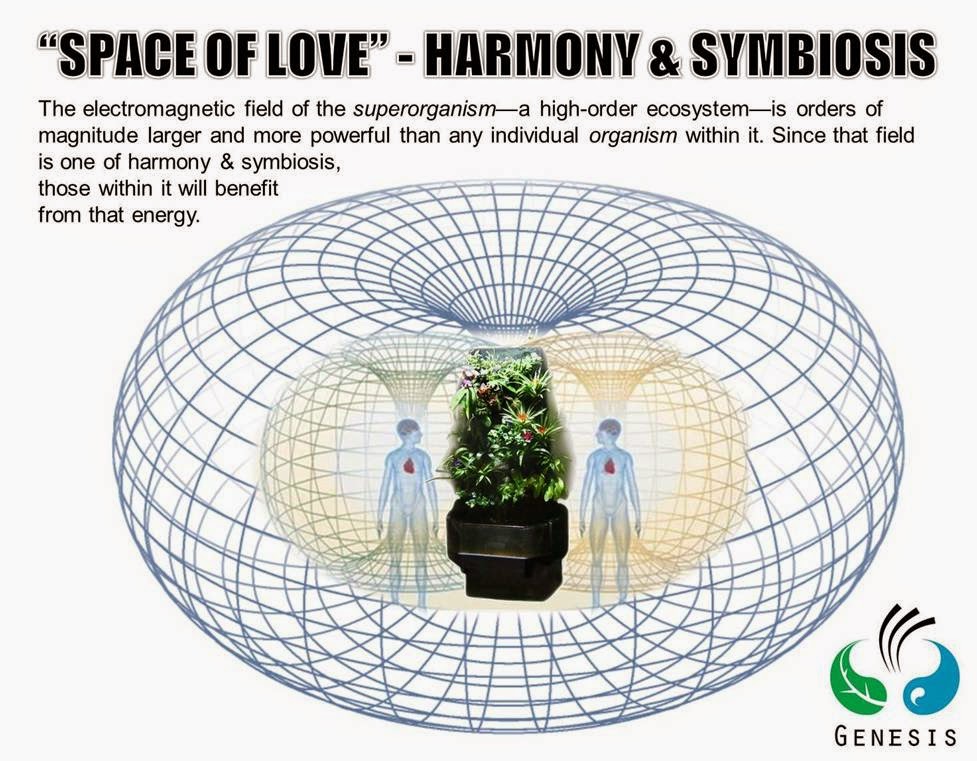
Infographics by GenesisEcoFund: More than Cooperative Co-ops:
If Cooperation is the cornerstone to a better society, ecosystems are the foundation to a better humanity

The idea of co-operatives is not new, just as the concept of co-operation is as old as humanity itself. But is co-operation all we need to overcome the challenges facing humanity in the 21st Century?

Co-operation is a very human concept. It suggests not only an agreement, but a conscious choice: a decision to co-operate versus some other alternative (i.e. compete). This then not only makes it an aspect of higher-order thinking, it ends up in the mental frameworks of cost-benefit analysis, etc.

It turns out there is something even more fundamental, more primal and far more instinctive than cooperation. And as always, it is found at the heart of nature, ecological relationships and at the heart of every ecosystem.

Harmony and mutual symbiosis is the foundation and framework of all nature. Competition exists at multiple levels within this broader, superior framework, but since competition serves the whole in the big picture, it too then is an aspect of harmony and mutual symbiosis.

What is good for one organism is ALWAYS beneficial to the ecosystem as a whole. Unless that organism happens to be a human.

Human beings are the only species who do not comprehend this fundamental law of nature: that any action taken in the microcosm will be reflected in the macrocosm. Thus, any behaviour by any particular organism must be aligned with the goal of the macro ecological goal, or it must be discarded.

Now clearly, since harmony and mutually symbiotic relationships are everywhere in nature, right down to single-celled organisms, such harmony is spontaneous, instinctive, inherent…individual organisms do not exactly have a say in the matter.

The fact that human beings do have a say in the matter is precisely what is to blame for civilizations’ dismal track record of abhorrent environmental stewardship…or better put, our complete inability to respect and maintain a harmonious and mutually symbiotic relationship with the planet.

This, despite the fact that most humans comprehend the importance of cooperation. So what’s going on?

How is it that human beings have such a dismal relationship with the macro environment, despite having such a firm grasp of co-operation, particularly in our personal and professional relationships? 

The answer comes back to the fact that co-operation is a limited human concept with a limited reach. Nature doesn’t function on cooperation, it functions on that more primal, instinctive, foundational thing…harmony and mutual symbiosis. 

Humanity’s compulsion to cooperate with fellow humans when need be and exploit everything and everyone else has led to the total lack of comprehension of what harmony and mutual symbiosis actually is.

So here we have organizations called “Co-operatives” or “CO-Ops” who like to think of themselves as superior to typical for-profit enterprise. What gives them that sense of superiority—a kind of moral superiority, as it were—is precisely the fact that their actions in the world are more likely to be beneficial to individuals, community and society by virtue that their cornerstone is co-operation. 

But sadly, when it comes to SUSTAINABILITY, co-ops are just as hamstrung as all other corporations and organizations…running around trying to apply this human-engineered system or that human-derived solution to problems which are INFINITELY MORE COMPLEX and FAR BEYOND THE REACH of human conceptions.

Even a Co-op, though theoretically positioned to do what is best for society, has no special advantage when it comes to sustainability, because nature cannot rely on its cornerstone of co-operation. Nature must function on something deeper, more foundational and infinitely more powerful than mere cooperation. Nature must have harmony and mutual symbiosis.

And now co-ops can have it too.

If co-operation is the foundation for a better society, then imagine what can be achieved with ecosystems? Imagine what happens when organizational culture is based on harmony and mutual symbiosis?

Just as the concept of co-operation leads to the co-op culture, stronger communities, and a better society; so too, ecosystems will lead to a culture of harmony and mutual symbiosis, true sustainability, and a better humanity—able to maintain harmonic and mutually symbiotic relationships with ecology and the planet.  

As in the microcosm, so will it be in the macrocosm. Developing a harmonious and mutually symbiotic relationship with nature within the walls and halls of your organization, is what will inspire harmonious, symbiotic and bio-mimetic behaviours, innovations and solutions that truly work.

Take your co-op to the next level. That's what we mean by more cooperative co-ops. 

Wednesday, April 22, 2015

EARTH DAY REFLECTION: You know that relaxed, refreshed, recharged feeling you get from nature? Why is that, do you think?

Image by Genesis Eco Fund: Earth Day Reflection: Mechanical Approach v.s. Sustainable Approach

“A mechanical, systems-based approach can only produce more exploitation because its foundation is separation. True sustainability emerges when we consciously embrace an ecosystems-based approach.” 
~ Wolfgang Amelung, Inventor & Co-Founder of Genesis EcoFund
Every Earth Day it’s the same thing: the world expounds on the virtues and necessities of saving the planet, and they point to the perils and evils of one kind of technology, while gushing over the benefits and glories of a different brand of technology, all the while missing the point entirely.

Have you ever been in nature? You know that feeling that you get? That relaxed, refreshed, recharged, clear-headed, balanced feeling? Why is that, do you think?

Maybe it's because our TRUE NATURE is NOT the mechanical mind we have and are trapped in most of the time: all our systems, linear thinking, engineered solutions--and their antithesis, our "escapism," desire for randomness and abstract thought, wanton destruction (even if its in movies, video games, or on the nightly news).

Maybe our true nature is reflected in the highest expressions of Mother Nature...not what we superficially see and describe in primitive linear relationships (competition, survival of the fittest, etc), but precisely what we don't see and what the mechanical mind cannot comprehend fully. But let's give it a shot anyway...

To truly comprehend the meaning of “Earth Day,” we must begin to comprehend that “the earth” has always had a second meaning as it applies to humanity. While this meaning is not exactly “hidden” in the strictest sense, it has been lost on most people.

“Earth” is another word for “soil;” the hume in the word hummus (a very “earthy” substance indeed); that is the stuff; earthstuff, if you will…the flesh of the earth. This sense of the word applies to the hume in human. In truth, the word human is a compound word meaning earth and mind (hume and manas).

Image: Earth, Hands  
Source: breisebreiseleighgoleire1969.wordpress.com: Breise! Breise! Extra! Extra!: News Headlines from around the world Septmber 11th 2011

THAT is why we feel so good in nature...because on some level we feel as though we've come home...held in the comforting bosom of our Mother's healing embrace.  In a very real sense, when we think about Earth Day, we should not avoid thinking of ourselves.

But we do. We see ourselves as somehow separate from the earth when in truth, we are the earth; it is us. This is both a physical and metaphysical phenomenon: it is a reality in every sense and at every level.  It is not the whole truth, but it is far closer to the complete picture than modern science (or even contemporary religion, for that matter) comprehends.

And therein lies the problem. We separate ourselves into a distinct category (human world v.s. the natural world). We believe ourselves to be lords over nature: that it somehow is ours to do with as we please; subject to any and every monstrosity our mechanical minds can conceive of.

What we call progress and civilization, built on so-called human ingenuity and technology, has been at the expense of the earth; of nature; and our own fundamental nature as earth! Our relationship with the planet is directly 1:1 analogous to our relationships with ourselves and each other.

Production, consumption, construction, destruction, addiction, affliction, subjugation, medication…anxiety, stress, SUFFERING.

And what’s our response? To continue the insanity, as Albert Einstein described it; that is, doing the same thing over and over and expecting a different result.

Humanity believes so-called advanced technology—the same old linear, binary, mechanical systems-based approach made more complicated and sophisticated—will save it.  Economists actually believe they can achieve perpetual growth by returning indefinitely to the wellspring of efficiency. But efficiency is at best only 1/6th of sustainability.

Image Collage by PeapodLife: It takes more than “efficiency” to be “GREEN”

All it takes is a conscious, honest, objective look within oneself and any and all of nature on this planet and in the vast expanse of the universe to know the utter tragicomedy of modern humanity’s thinking…nothing in the physical universe lasts forever: not even planets, stars or galaxies.

So what’s the Answer?

It’s quite simple, really. We advance with a conscious appreciation of authentic nature. We throw away the crude linearity of a binary existence—the legacy of our mechanical systems-based approach—and embrace the infinite complexity of an ecosystems approach.

Instead of imposing a mechanical bias on nature (which is a crude and superficial understanding at best) and subjecting it to the unspeakable horrors such cold, heartless calculations create in the real world, we expand our consciousness and with objectivity embrace the reality of nature…harmony and mutual symbiosis...as modelled by ecosystems.

Only nature can create authentic sustainability. And even then, we must acknowledge and accept that the cycles of birth, death and sacrifice are fundamental to the nature of all things—ourselves, our civilization, and our planet is no exception.

The beauty is, once you start embracing an ecosystems approach—once you immerse yourself in the electromagnetic field of an indoor ecosystem and open your consciousness to your participation in it and relationship with it—you settle into the unavoidable laws of the universe…inspiration, innovation and comprehension follows.

By comprehension we mean a deep, conscious appreciation and direct experience of the nature of yourself and all things; this is not an intellectual pursuit, and cannot be achieved by reading books or any other intellectual means. However, it can and must be experienced for real personal growth; and is the REAL SECRET behind every major paradigm-shifting advancement in any and all fields of pursuit:

  • Sir Isaac Newton discovered Gravity meditating under an apple tree
  • Einstein discovered relativity while taking a bubble bath
  • Beethoven's 5th symphony was inspired by birdsong
  • and countless other examples

ONLY nature has this power...to help us achieve our highest potential, because that is the very purpose and meaning of EVOLUTION itself!

And, as it turns out, conscious comprehension and direct experience of the nature of ourselves and all things is the birthright of humanity, the dream of every living being, and represents the real “progress” and true sustainability for our individual 'earth,' and the planet as a whole.

In other words, "No man is an island." What would the planet be without the Sun's rays and the moon's rhythms? So too, we as individual 'earths' need our immediate environment to support us and vibrate in ways which optimize our lives--mind, body and soul--so that inspiration, innovation and solutions to so many of the problems the planet faces will automatically be aligned to the underlying paradigm of life itself: harmony and mutual symbiosis.

This is the mission of Genesis Eco Fund, and our hope for you and the whole planet from this Earth Day forward.

To look at all this in a slightly different way, contemplate the following quotation which has been attributed to Chief Seattle, although according to Barefoot Windwalker it is neither “historically accurate, nor even something that Chief Seattle said” regardless…

“This we know: the earth does not belong to man, man belongs to the earth. All things are connected like the blood that unites us all. Man did not weave the web of life, he is merely a strand in it. Whatever he does to the web, he does to himself.”
~ Chief Seattle
Source: barefootsworld.net: CHIEF SEATTLE'S LETTER
Image: Quote by Chief Seattle, “This we know: the earth does not belong to man…” 
Source: www.plentifulplanet.com

Related Links:
Earth Day Canada
Earth Day Network
PeapodLife

Tuesday, March 31, 2015

Ecosystems, Entrainment, & YOU…
Meet Choronobiology & Biomusicology

“Man, brain, heart electromagnetic field” 

Hopefully we don’t have to go over what an ecosystem is. By now one would hope most people have a grasp of the concept. Of course, from Genesis Eco Fund’s perspective, in addition to what everyone else says it is, to us an ecosystem is also a superorganism which generates a field of harmony and mutual symbiosis…a field of love.

So what is “entrainment,” and what does it have to do with ecosystems? For that, let’s switch from tell to show:

Video: Synchronization of Metronomes 
Credit: Harvard Natural Sciences Lecture Demonstrations

With a video like this It’s easy to see what entrainment is: in this case the shift from diverse to uniform oscillation. (There are MANY versions of this experiment available to watch on You Tube. We chose this one because it’s affiliation with Harvard lends it a bit of credibility in the eyes of sceptics and trolls.)

According to Wikipedia, Entrainment the above video demonstrates Entrainment in physics, or the process where two interacting oscillating systems assume the same period. However, it may refer to a number of additional phenomenon, most notably for our discussion:
1.    Entrainment (chronobiology), the alignment of a circadian system's period and phase to the period and phase of an external rhythm
2.    Entrainment (biomusicology), the synchronization of organisms to an external rhythm including such phenomenon as:
   a.    Brainwave entrainment (entraining one's brainwaves to a desired frequency) 
   b.    Lexical entrainment, the process in conversational linguistics of the subject adopting the terms of their interlocutor
Source: Wikipedia, Entrainment

So today’s article is going to look at each of these phenomenon and hypothesize the effects of an ecosystem based on the established science. 

1. Ecosystems, Entrainment & Chronobiology

According to Wikipedia,

Chronobiology is a field of biology that examines periodic (cyclic) phenomena in living organisms and their adaptation to solar- and lunar-related rhythms.[1] These cycles are known as biological rhythms.”
Image: Biological clock human

Entrainment, within the study of chronobiology, occurs when rhythmic physiological or behavioral events match their period and phase to that of an environmental oscillation. A common example is the entrainment of circadian rhythms to the daily light–dark cycle, which ultimately is determined by the Earth's rotation. The term entrainment is justified because the biological rhythms are endogenous: They persist when the organism is isolated from periodic environmental cues. Of the several possible cues, called zeitgebers (German for 'time-givers', 'synchronizers'), which can contribute to entrainment, bright light is by far the most effective. Exercise may also play a role in determining circadian rhythm.”
Source: http://en.wikipedia.org/wiki/Entrainment_%28chronobiology%29

HYPOTHESIS #1:  Ecosystems should help you sleep better.

An ecosystem, as a superorganism, will be Chrono biologically entrained to the natural rhythms of the planet, and this will be reflected in its electromagnetic field. Anyone in this field will experience some degree of chronobiological entrainment by proxy. Circadian rhythms will have a tendency to normalize and individuals should be able to sleep better.

2. Ecosystems, Entrainment & Biomusicology

According to Wikipedia,
“Entrainment in the biomusicological sense refers to the synchronization of organisms to an external rhythm, usually produced by other organisms with whom they interact socially. Examples include firefly flashing,[citation needed]mosquito wing clapping,[1] as well as human music and dance such as foot tapping.”  
Source: http://en.wikipedia.org/wiki/Entrainment_(biomusicology)

An example of this includes brainwave entrainment, so popular in the New Age movement and even Self-Help circles. Here is a sample:

Video: 1 Hour Theta Brainwave Entrainment Binaural Beats 8 Hz - "Good for learning new Information" 

If you actually follow the advice in the video and try it out (headphones work best), it is unquestionable that the frequencies in the audio are having an effect on your brain. The real question is what if any long-term benefits are you gaining from this? Or is it just a nice way to relax and “cleanse” the mind of all the garbage it accumulated through the day/week.

We are not here to debate the metaphysical benefits of such “meditation technology,” but rather ask the poignant question: is aligning a natural and biological organism to a mechanical (synthesized) frequency really the right way to go?

HYPOTHESIS #2 a):  Ecosystems are the BEST for your brain.

Clinical studies have been done into the calming/healing power of nature sounds. If follows that any biomusical entrainment experienced with a superorganism whose energy frequency is in a constant state of balancing and achievement of optimal function for every organism within it, it follows that any human being (and brain) in the affective zone of said reach will likewise benefit.

Another example of biomusicological entrainment is lexical entrainment, or the tendency to pick-up on and mimic—if not adopt outright—the speech patterns and tendencies of others in social situations. The problem? Disagreements can quickly escalate into arguments if each individual begins getting caught up in the other’s hostility.

Think of a ping-pong match which starts out fairly calm and benign, but quickly escalates into an all-out war.

HYPOTHESIS #2 b):  Ecosystems are the BEST for your relationships.

Be it in the home or in the workplace, if there is a superior enveloping field of love, the tendency for individuals to be afflicted by hostility—and effected by the hostility of others—is reduced. The soothing, calming influence of the entraining effects of the ecosystem act as a buffer, a balm if you will, and a moderating force taking the edge off otherwise tense human interactions.

What’s Next?

Experience it for yourself.

Yes, Genesis Eco Fund has committed itself to promoting and conducting research into ecosystems and their effects on human beings. And we will continually update our blog and website with related research information when it becomes available.

Ultimately, the best way to know for sure if you, your family and/or your organization can benefit from having an ecosystem in your life is to try it. See the difference entrainment and ecosystems have in your life. 

Thursday, March 12, 2015

The Natural PATH to ‘Smart Cities’ 
takes Advanced Human Habitat on the Road

Image Collage by Gensis Eco Fund: The Natural PATH to Smart Cities 


Recently, Upworthy posted an article entitled I never realized how dumb our cities are until I saw what a smart one looks like. The blog post included snippets and commentary about a 20-minute report by CBC News, The National on “How Cities Make us Sick.” We have included the complete video, below.

Video: How Cities Make Us Sick 

Now, we are not refuting the questioning of so-called “obesogenic environments;” that is, cities being designed around cars, fundamentally antithetical to regular physical activity, and essentially major contributors to the obesity epidemic.

However, better transportation does not a healthy city make. And the idea that a ‘smart city’ is one which promotes physical activity is just another in a long series of oversimplifications and ‘magic-bullet’ solutions that humanity is so enamoured by and prone to fall for—until they reveal their inadequacies.

If we take a biomimetic, ecosystem view (and at Genesis Eco Fund we know there is no better approach to take to solve questions of environment and human health, since inherent human health is defined by biology, environment and natural law), we must look at a community at a more fundamental level.

A community is an ecosystem--a super-organism—which is itself a collection of smaller organisms. Expressed on a smaller scale, a community is a functioning organ made up of many smaller cells. The overall health of the organ is dependent on the health of its cells. True, a handful of cells can be damaged or diseased without the organ collapsing; but a cascading mass failure of cells will result in organ failure.

Now, it is also true that organs have inter-cellular systems, including transport and energy systems. And, it is also true that failure of these systems can also produce organ failure: for instance, blockage of an artery in the heart will most likely result in a heart attack. It so happens in the case of the heart that transportation is a primary key to heart health. But free-flowing arteries do not alone make a healthy heart. What if, for instance, the blood cells themselves are diseased?

This is the point we are discussing here today. While it could be argued that the movement of people from A to B is a primary necessity of a well-functioning city, what if the people being moved from A to B are “sick?” So here we return to the first premise, that the chosen mode of transportation in most cities—the automobile—promotes obesity.

But this is still only looking at one aspect of the city…transportation. What about the health of the rest of the environment these ‘blood cells’—people—spend their time?

What about toxic sick buildings? What about stressful home, work, school, healthcare environments? No matter how much time we travel to and fro within the city, we spend far more time at various destinations than we do on the journey. To say that a smart city is defined solely by its transportation system ignores the cellular nature of all cities. If people are literally “the lifeblood” of a city, their home, office, school, etc. are the other “cells” they nourish (and are nourished by). Getting them from one cell to the next is an afterthought.

Ecosystems create Advanced Human Habitats—cleaner air, more relaxing, less stressful living spaces, spaces of harmony and symbiosis which boost mental function, psychological wellbeing, energy, vitality and immune system. You’re going to eat much healthier and make healthier lifestyle choices once you live in Advanced Human Habitat…because the environment supports Advanced Humans.

Video: Fitch Street Living Wall EcoSystem 6-Month Update

Want people to walk more and ride their bicycles in Toronto, even in the dead of winter? Make more underground walkways and cycling paths and line them with rainforest ecosystems. Just imagine riding your bike to work past an ecosystem like the one above. It’s not as expensive to do walkways and cycle paths as it is road tunnels or subways, and the health and wellness benefits are many.

These underground walkways (like the PATH, downtown) are also much cooler in the summer (the ecosystem will help with that), and it will be that much easier for someone to hop on a bike or trike and ride across town when they are in a refreshing cool transportation artery when it’s 30 degrees Celsius and humid above ground.     

Image: PATH, Toronto 

(There has been talk of expanding the PATH, like this article from 2011 in The Globe and Mail: Toronto mulls plan to expand world's longest underground shopping complex. )

And when you arrive at work or at school? Imagine being greeted with the same refreshing, clean, oxygenating, relaxing, rejuvenating atmosphere as your ecosystem-lined “PATH” was.

Just imagine how incredible that would be.

And how ‘smart.’

Tuesday, December 16, 2014

Did the Romans know more about the Nature of Concrete than we do?

Image: The concrete walls of Trajan’s Markets in Rome have stood the test of time and the elements for nearly 2,000 years.
Credit: Marie Jackson 
Source: sciencedaily.com: Back to future with Roman architectural concrete: Advanced light source reveals key to longevity of imperial Roman monuments
“The architect should be equipped with knowledge of many branches of study and varied kinds of learning, for it is by his judgement that all work done by the other arts is put to test. This knowledge is the child of practice and theory.”
~ Marcus Vitruvius Pollio, De architectura, ~ 15BCE.
Source: http://en.wikiquote.org/wiki/Vitruvius
It’s never an easy idea to swallow: the ancients may have known things that we don’t. They were able to accomplish things which we can’t, despite all our knowledge and technology.

Actually, the idea that the ancients were superior to us in any way at all is a “crackpot notion” which is never acknowledged by present day “experts,” despite there being hundreds of observable phenomena and material achievements which defy all explanation by modern scholars.

Egypt is a great source of such enigmas. From the colossal—the Great Pyramid of Giza itself—to the small—onyx vessels with a tiny neck perfectly carved from a single stone, no one knows for sure how the Egyptians could manage various feats of engineering given the “consensus” view of what tools, materials and technology were available to them at the time.

The Roman civilization had its own secrets which scientists have only recently begun to decode. Among them, the incredible durability and longevity of Roman concrete.

From the Pantheon, Trajan’s Markets and the Colosseum to any number of incredible concrete structures throughout the ancient capitol and beyond, modern architectural engineers can only gaze in wonder and marvel at technology which has stood the test of time and the elements for almost two millennia.


Image: Gardiner Expressway versus Roman Concrete. 

And if you think the above comparison of Roman concrete to the Gardiner Expressway, consider that Marie Jackson, lead author of two papers on the subject, said “Roman concrete has remained coherent and well-consolidated for 2,000 years in aggressive maritime environments…It is one of the most durable construction materials on the planet, and that was no accident. Shipping was the lifeline of political, economic and military stability for the Roman Empire, so constructing harbors that would last was critical.” Source: http://newscenter.berkeley.edu/2013/06/04/roman-concrete/

Well thanks to Jackson, a team of researchers and advanced imaging techniques, modern technology has a shot at redemption.

“Using the Advanced Light Source at Lawrence Berkeley National Laboratory (Berkeley Lab), a research team from the University of California, Berkeley, examined the fine-scale structure of Roman concrete. It described for the first time how the extraordinarily stable compound – calcium-aluminum-silicate-hydrate (C-A-S-H) – binds the material used to build some of the most enduring structures in Western civilization.” Source: http://newscenter.berkeley.edu/2013/06/04/roman-concrete/

Here’s an idea of what it looks like:

Image: This scanning electron microscope image shows crystals of a rare mineral, Al-tobermorite, magnified about 25,000 times. UC Berkeley researchers characterized Al-tobermorite in samples of Roman concrete. Credit: UC Berkeley 


According to researchers, manufacturing Roman concrete not only promises a more durable product; it’s more sustainable too: using far less heat energy than the standard Portland cement (the key ingredient in modern concrete) and leaves a much smaller carbon footprint.

At 19 billion tons, some estimates place the carbon emission contribution of Portland cement to be 7% of our overall carbon footprint. No small sum, given all other sources of atmospheric CO2.

At Genesis Eco Fund, we think there’s something more fundamental about this research, which is sadly lost on the researchers but significant.

 Image: Nikola Tesla’s assertion that crystals are alive.   
“Crystals are living beings at the beginning of creation."
~ Nikola Tesla
Crystals are alive.

The descriptions provided about how Roman Concrete was produced—and that it was composed of mortar formulated from lime, volcanic ash and chunks of volcanic tuff and brick—indicate an aggregate which is alive versus the lifeless concrete of today.

Consider:

“The mineralogical changes that Jackson and her collaborators observed showed the mortar reproduction gaining strength and toughness over 180 days as calcium-aluminum-silicate-hydrate (C-A-S-H) cementing binder coalesced and strätlingite crystals grew in interfacial zones between volcanic scoria and the mortar matrix. The toughening of these interfacial zones is reflected in the bridging crack morphology, which was measured by co-author Landis at the University of Maine, using computed tomography scans of the fractured mortar specimens. These experimental results correlate well with computations of increasing fracture energy determined by co-author Brune, now at Dupont Technologies. The strätlingite crystals show no corrosion and their smooth surfaces suggest long-term stability, similar to geological strätlingite that persists for hundreds of thousands of years.” Source: http://www.sciencedaily.com/releases/2014/12/141215185026.htm

In essence, the situ crystallization of the strätlingite crystals produces an interfacial microstructure which is superior to that of modern-day Portland cement, whose porosity is what gives rise to cracks and fractures.
In the end, it would seem the Romans knew something about the true nature of crystals and crystallization and its effects on the nature of concrete. 

The bottom line?

Given the climatic changes and geological challenges facing modern civilization, we would do well to continue looking into ancient methods and materials which have stood the test of time. More importantly, to expand our minds and embrace ancient philosophies related to the nature of things, philosophies which modern science is slowly discovering were really “natural philosophies” that is, the original name given to the study we know today as science.

Certainly, using living materials is the hallmark of any truly Advanced Civilization, and a requisite for Advanced Human Habitat.

Tuesday, November 25, 2014

What can the Ferguson Riots teach us About Ourselves and the Flower of Life?

Image: Rioters surround a Saint Louis County Police cruiser as the city of Ferguson and the whole U.S. reacts to a grand jury’s decision not to indict Ferguson police officer Darren Wilson in the shooting death of unarmed teenager Michael Brown.
“Folk caught up in a riot aren't our cousins and sisters, our brothers and uncles. They are part of a big animal with many arms and claws, armed with stones and sticks.”
~ Tamora Pierce, Terrier
Yesterday’s decision by the grand jury not to indict Ferguson police officer Darren Wilson in death of unarmed teenager Michael Brown set of a firestorm of controversy and protest across the United States. In Ferguson itself, the anger and outrage intensified and the usual angry mob mentality was set loose on the town.

Riots, looting, burning police cars and businesses. It’s all over the news and the Internet. As is the outrage over the decision, discussions of racism and inequality, violence and acceptable use of force, law enforcement the reasonable expectations placed on officers facing possible harm, etc.

Genesis Eco Fund is not here to debate any of those issues. We leave that to the masses and the pundits. What we are here to do is extract practical knowledge that everyone can use—knowledge about ourselves, each other, how we interrelate on a fundamental level, and how our awareness of those foundational interrelationships can lead to strategies for living a more balanced, harmonious life.

In the Eye of the Storm

We all know what it’s like to “get caught up in” the moment. Be it at a rock concert, a party, a family gathering, or any group dynamic, we’ve felt ourselves “sucked into” as state of elation, excitement, laughter, anger (or even rage), fear, sadness or any number of emotional states.

If our emotional state resulted in us behaving in a certain way which we later regretted, we might even have chalked is up as “in the heat of the moment,” or “a victim of mob mentality.” But what was really going on with us? Truly, we were caught in a maelstrom of energy.   

Image: In the eye of the storm: Electromagnetic Field Vortex 

Recent research has shown the energy field of the heart, our emotional centre, to be 100,000 times stronger electrically and 5,000 times stronger magnetically than that of the brain, or intellectual centre.

Physics demonstrates that a change in our electromagnetic field causes transformation at the atomic level. Our electromagnetic field reflects our emotional state; and, the state of others’ electromagnetic fields can affect our electromagnetic field…affect our state.

Video: Heart’s Intuitive Intelligence and how electromagnetic fields generated by the heart (emotional energy fields) interact.

If we observe ourselves during moments of emotional confrontation with another, we can actually feel ourselves affected, influenced by their state, as shown in the above excellent video by the Institute of HeartMath. The more sensitive we are, the more likely it is we will be affected.

Quite simply, we are experiencing interference patterns from a “negatively charged” electromagnetic field. The flow of energy is of a certain frequency reflecting the emotional state of one individual interferes with the frequency of another and thus emotional state of another. Pretty simple, really, and something anyone can observe and experience directly, consciously, if they pay attention.

Image: Interface between electromagnetic fields. 

But this still doesn’t explain mob mentality. After all, are we not still all individuals? How is it that one person’s negative energy can interfere with the electromagnetic field of hundreds of people? The answer is simple, and something known to humans thousands of years ago, expressed in the symbol of the flower of life.

Video: How electromagnetic fields (torus) compound each other to create powerful morphogenetic fields, shown in “the flower of life.” 

In the above video taken from the documentary film Thrive, we see how torus, the shape of our electromagnetic field, compound one another in 3-dimensional space to produce a larger morphogenetic field magnitudes larger and more powerful than the electromagnetic field of any individual. Any new individual entering the larger field is affected by the state of the field, which in turn reflects the state of all individuals within it. The cascading effect from one individual to another compounds and the whole larger field begins to exert a tremendous power over the individuals caught within it.

This is why, for instance, completely law-abiding citizens can find themselves committing crimes in a mob they would never have done as an individual. The overarching electromagnetic field has them; their individual emotional state is being defined by the morphogenetic field.

This is how the planet’s electromagnetic field is partly created. All things which have an electromagnetic field are part of the megaorgansim of the planet. Its various ecosystems being superorganisms, themselves having morphogenetic fields made up of electromagnetic fields of individual organisms.

Image: Electromagnetic field of the planet 

The Good News from Ferguson

What’s true for riots fed by anger, frustration, hear, rage and other negative emotions, is equally true for peace, love, compassion, empathy, harmony and other positive emotions.

What’s more, anyone who has spent any time in nature knows this is the case. When we immerse ourselves in the morphogenetic field of a beautiful natural environment, we feel, immediately, the calming, soothing, peaceful, harmonious, loving state of that natural environment.

The power of nature to heal us emotionally and physically is related directly to this energetic influence over our electromagnetic field. Our field may be charged negatively, according to our state, but an ecosystem functions on collective harmony and symbiosis. Nature is love.

And so, indoor ecosystems, like those produced by PeapodLife, create spaces of love.

Image: An ecosystem 

Ecosystems are never negatively charged, unless they are dying.  But ecosystems are designed for sustainability, adaptability and longevity. It takes a shift in the larger electromagnetic field of the planet for an ecosystem to die—the ravages of human stupidity notwithstanding.

Regardless, one can see how beneficial it would be to have such an overarching positively charged morphogenetic field in one’s life—home, workplace, school, healing centre, etc.

Imagine what it would be like to be able to feel the same way you do when you go up north, camping, skiing, or to a tropical paradise…without having to go anywhere? Imagine the benefits to humanity if they began living in Advanced Human Habitat—advanced habitat for humans; habitat for advanced humans.


Tuesday, September 23, 2014

“Smarty Plants” & the Roots of Plant Intelligence


“We think the Sagebrush are basically eavesdropping on one another.”
~Rick Karban, U.C. Davis Ecologist
Source: The New Yorker – The Intelligent Plant

A few weeks ago, PeapodLife posted a blog entitled Do Plants Hold the Secrets to Consciousness? . Today, we offer a good deal more dramatic evidence that plants not only behave, it is quite possible they have complex behaviour and even intelligence.

Genesis Eco Fund also wrote on the topic of plant communication as it relates to ecosystems back in July: Do Trees Communicate? Ecosystems & the Communication of Plants.

Mainstream materialist science has no choice but to accept plants are not the passive organisms it assumed them to be. And while many still dismiss the notion of plant intelligence, others are embracing a different view.

Probably the most well-known of these is Stefano Mancuso, Plant Neurobiologist. Here is his TED Talk from 2010:

Video: TED Talk - Stefano Mancuso: The roots of plant intelligence 

Listening to the passion of his presentation, one can easily comprehend why Mancuso is the Co-Founder of LINV - International Laboratory of Plant Neurobiology.

Plant Neurobiology? Plant Neurobiologist? But plants don’t have a brain. “If you are a plant, having a brain is not an advantage,” Mancuso says. And yet, he has dedicated his life to the pursuit of plant intelligence. Source: http://www.newyorker.com/magazine/2013/12/23/the-intelligent-plant

There is certainly much more which could be said on this topic.

For starters, the conversation must invariably and inevitably move from the question of individual plant intelligence, or indeed, plant and animal intelligence, to one of ecosystem intelligence. That is, the ability for the superorganism to exhibit behaviours which show intelligence.

And certainly, in the view of Genesis, the conversation must (and will) eventually migrate from the question of intelligence, to the issue of consciousness and the discussion of what these two terms describe and how they differ from one another.

But today, we think we’ll just share some more videos demonstrating that something is indeed going on with plants, and it’s a secret world that we’re only just beginning to explore in any meaningful way.

Video Link: Mind of Plants: Documentary on The Intelligence of Plants, produced by Gédéon Programmes, K Production, ARTE

Video Link: Nature: What Plants Talk About – Documentary


Tuesday, August 26, 2014

Relationship with Nature = Path to a “Growth Mindset”
Living with Ecosystems = Antidote to a “Fixed Mindset”

Image (Infographic): Two Mindsets 
Credit: Carol S. Dweck Ph.D. Graphic by Nigel Holmes

“I have always been deeply moved by outstanding achievement and saddened by wasted potential.”
~ Carol Dweck, Ph.D., Author, “Mindset”
The above infographic and quote come from Carol S. Dweck, Lewis and Virginia Eaton Professor of Psychology at Stanford University and one of the world’s foremost researchers in the field of motivation: why people succeed and what fosters success.

In her book, “Mindset,” Dr. Dweck explores a relatively simple idea, which flies in the face of some fairly well-established notions of success—what it takes to succeed and how to encourage success—namely, that brains and talent alone do not guarantee success, and that praising these factors (and rewarding them) may in fact jeopardize success.
“In a fixed mindset, people believe their basic qualities, like their intelligence or talent, are simply fixed traits. They spend their time documenting their intelligence or talent instead of developing them. They also believe that talent alone creates success—without effort. They’re wrong.

“In a growth mindset, people believe that their most basic abilities can be developed through dedication and hard work—brains and talent are just the starting point. This view creates a love of learning and a resilience that is essential for great accomplishment. Virtually all great people have had these qualities.”

Source: http://mindsetonline.com/whatisit/about/index.html
Disclaimer: we haven’t read Dr. Dweck’s book; we can neither critique her work nor offer any commentary about her methods of analysis.

We can, however, agree with her conclusions—her basic theory—especially as summarized in the above infographic; and moreover, offer a path to circumventing the fixed mindset trap and adopting a growth mindset instead.

You guessed it: once again ecosystems; nature show us the way.

We can say many things about nature—many theories, opinions, judgments, and beliefs—but one cannot deny the fluidity of the natural world. IN NATURE NOTHING IS FIXED.

Even the hardest substances known to man, diamonds, are in constant motion—vibration. Moreover, in their natural state, diamonds—being crystals—do actually “grow.” 

Video: Timelaps of Crystals Growing  by EsotericWorlds
Growing crystals on a microscope slide in cross-polarised light.

Now, if the hardest, most stable substances in nature known to humankind are also the most valuable (diamonds, gold) what does that tell you about the state of our psychology? Well, just look around at the world created by human beings.

Our psychology, like the world around us, is mechanical. It is not organic, fluid, adaptive, receptive, dynamic. Generally speaking our thought patterns are rigid, restrictive, repetitive, stubborn, etc. Our world is one of concrete buildings, machines, assembly lines, digital technology…we like it that way, because our generally fixed mindsets like it that way…mechanical, predictable, solid, controlled.

Now let us look at nature. Sure, there are rules and mechanical laws which nature abides by—gravity and the other mechanical laws of physics come to mind—but within the framework of a broad set of theses parameters, the observable universe is anything but rigid.

Yes, nature definitely has a mechanical level—that’s the one that we observe simplistically with our mechanical psychology and declare ourselves worthy of “lording over”—nuclear weapons, GMO’s, and all other manner of humans playing gods with the “Lego pieces of life” are the result. 

But nature has another, more subtle level. That level is anything but mechanical. That is the level that one can actually form a real relationship with…like the indigenous peoples of the world did so effectively. It is an intelligentsia of loving and nurturing compassion. It is explorative, experimental, but natural and gradual in its experimentation…evolution and devolution.

The intelligentsia of ecosystems is trans-organismic. It is the only way to achieve collective harmony and symbiosis. Those who study chaos theory and fractals understand there is a level of organizational technology at work in nature which goes beyond mechanistic nature

Living with an ecosystem opens one’s awareness to these subtle goings on…not intellectually, necessarily…consciously.

One does not intellectualize one’s relationship with nature. One feels oneness, kinship, wholeness with nature. It is a complete, holistic, conscious knowing. It is an expansive knowledge which may inform the intellect, certainly, but is not the product of deductive reasoning or any rational cognitive function whatsoever. Quite the contrary, love of nature is for all intents and purposes quite irrational at times (as so many examples of love, selflessness, altruism, self-sacrifice, etc. are).

This, then, is the realm of growth. A microbiologist can assert quite rationally that the process of growth is 100% mechanical—for instance, in the case of a bacterium)—and that cell division and reproduction happen like clockwork, causing the growth of a bacterial culture.

And what of the medium? What of the environment? The ecosystem? They observe how bacterial colonies change and adapt their growth according to changes in their environment; but do they comprehend that the same phenomenon is taking place on more subtle, energetic levels? No, their mindset is fixed on a materialistic mechanical understanding and so they remain fixated on theories which support and perpetuate said mindset.

At Genesis, we—like Dr. Dweck—are saddened by “wasted potential.” That is why we promote the integration of ecosystems into the education and support of humanity. If we know nothing else, we know this: nature has been around for a lot longer than our materialistic science and technology; and, that it will continue long after we are gone.

Whereas our mechanical monstrosities and fixations with what “lasts forever” in our minds will be long gone, nature’s intelligent cycles of constant change will continue—evolving into new and wonderful and surprising versions of themselves—giving rise to new and incredible creations.

We can choose to be a part of such a fantastic future…we can choose to truly grow. Or, we can choose to cling to our fixations—fixed mindsets—and go obsolete along with all our precious gadgets.

=========================

A quick shout out to Nature Daily.

Thanks for picking up PeapodLife’s blog post from last Thursday, 21st of August, Mission Blue: CODE RED - New Relationship with Nature Required!

Image (Screenshot ): PeapodLife: Mission Blue: CODE RED New Relationship with Nature Required!
Shared by Genesis Eco Fund from The Nature Daily
Source: The Nature Daily Science Top Stories Thursday, Aug. 21, 2014


Tuesday, July 15, 2014

What Role can Ecosystems Play in Changing Education Paradigms?

Video: RSA Animate - Changing Education Paradigms; 
Credit: RSA Events; Sir Ken Robinson www.theRSA.org in Accordance with RSA Policy Statement 

“If the misery of our poor be caused not by the laws of nature, but by our own institutions, great is our sin.”

We at Genesis Eco Fund are very much concerned with the issue of education, but not in the trite, cliché treatment it normally receives: by parents, teachers, employers and—worst of all—politicians and bureaucrats.

Genesis Eco Fund concerns itself with the machinery of education (that is, what it has become). Not just “the education system” as it were, and certainly not “the institution of education.” Rather, the unquestioned assumptions regarding the institutionalization of education as a matter of natural course.

With that in mind, we share the above video by RSA Animate featuring a talk by Sir Ken Robinson (about the need to reimagine the paradigm of institutionalized education as we know it (as some kind of “natural” phenomenon). Not least in the light of the quote by Charles Darwin.

Image: Charles Darwin Quote on Slavery, “If the misery of our poor be caused not by the laws of nature…” (1836)  
Source: todayinsci.com: TODAY IN SCIENCE HISTORY: Charles Darwin Quote on Slavery (1836)

The fact is, the “emerging problems” of education are, in-fact, inherent in the underlying myth that the institutionalization of the current system is natural. It is not at all natural; it is, as Ken Robinson points out, a myth!

What else unnatural, Mr. Robinson goes on to say, is the current paradigms’ lack of recognition that “most great learning happens in groups,” that is to say “collaboration is the stuff of growth; and, that the current educational model of atomizing and judging people separately, we “form a kind of disjunction between them and their natural learning environment.”

This statement could easily describe ecosystems. What is collaboration after all? Collective harmony and mutual symbiosis…the modus operendi of ecosystems. So what about the apparent competition of said ecosystem? What of our friend Darwin’s famous axiom “survival of the fittest”?

Ironically Social Darwinism (very prominent when the current educational paradigm was established) is to blame for the insistence on standardized testing and pitting individuals against one another. But this is inherently counter-productive to the collaboration just mention; and, as it turns out, is ultimately a bit-player in the functioning of ecosystems!

In other words, survival of the fittest may be a natural phenomenon, but human beings have placed far too much emphasis on it and not the more fundamental law of nature: harmony and symbiosis. Survival of the fittest as “understood” by Darwin and everyone since is an ego-projection. Darwin found a phenomenon in nature which provided him with a reasonable theory to explain “the origins” of our linear, intellectual, reactionary experience of conflict (personal, tribal, social, national, etc).

The problem is, Darwin didn’t see the bigger picture. He saw organisms only in isolation according to classical definitions of human conflict (man vs. man, man vs. nature): individual vs. individual, pack vs. pack, individual and/or pack vs. nature. Darwin didn’t see ecosystems; he certainly never stopped to recognize that ecosystems are “super organisms” (that evolve, have interests, etc).

Competition (testing of individuals against each other, the environment, etc.) is part of the constant balancing inherent in symbiosis and harmony, just as any collaborative group encounters conflicts and conflict resolution as the inevitable differences and competing interests of individual are integrated into the whole collaborative effort. And yes, struggle and death are a part of life, but not according to some linear equation, or massive “us versus them” oversimplification as experienced by human ego-intellect!

In other words, individuals have clearly defined personal goals, but in a successful collaborative effort (sports team, business, etc.), individual goals are aligned into the collective goal, such that cooperation trumps competition by far! This is how nature really works…ECOSYSTEMS!

Example: many “favourites” for this year’s world cup had “superstar” players whose individual interests included “showing their nation and the world they are deserving of such praise and adoration.” Germany had a solid team of players whose individual interests were aligned with the collective interests. How often we saw German players in position to “go for glory” instead pass the ball to a teammate in a much better position to get a goal—and pass and score Germany did. And the results speak for themselves.

Image: “There is no “I” in “team” Germany 2014 

And then at 11:00 minutes into the talk, Sir Ken drops this bombshell:

“It’s about the habits of our institutions and the HABITATS THEY OCCUPY.”

The very presence of ecosystems in an institution changes the habitat of that institution. One CANNOT occupy an ecosystem and not be a part of it. One cannot be a part of an ecosystem and not experience an alignment of one’s individual goals with those of the collective.

This alignment is bi-directional. In other words, just as your habits change to align with the habitat, the ecosystem adjusts to accommodate your goals.

Example: Germany had solid players: Klosse, who became the winningest player in world-cup history, for instance. But the culture of collaboration meant he didn’t “go for glory.” He was just another equal member of the team.  He wanted to win. His team wanted to win. He probably did want to break the record, but his personal success was secondary to his team’s success. In the end, that formula for success allowed him to indeed accumulate the goal count he was looking for…but not at the expense of his ecosystem.

Example: let’s say you want to be healthy, happy, peaceful, etc. The ecosystem also seeks harmony and healthy—optimal levels of performance for all its members. There is a clear and obvious alignment.

But what if you are a smoker? Sure, you want to be healthy, but you just can’t break this habit which relaxes you? In the short run, the ecosystem will synthesize bacteria to break-down tar and nicotine in the air. Over time, your presence in the habitat of clean air, positive energy, and natural calming power of nature will reduce your need to turn to cigarettes. Our habitat affects our habits. Plain and simple.

Image: Stillframe from Video: RSA Animate - Changing Education Paradigms; 
“The habits of our institutions and the habitats they occupy…” 
Credit: RSA Events; Sir Ken Robinson www.theRSA.org in Accordance with RSA Policy Statement

So, too then, with the institution of learning. And let’s face it, one look at an ecosystem and one realizes that lateral, divergent thinking, inspiration, imagination, and all the wonderful preconditions for real creativity are all there…naturally. Truly.

And that’s all just the tip of the iceberg of how ecosystems can change any institution, especially education (which is, let’s face it, supposed to be all about GROWTH). If education is all about growth, then the ONLY model, the ONLY paradigm that will ever work is THE TRULY natural, effective and proven model for growth: ecosystems. Here we coin the phrase: “Survival of the most fitting?”

Tuesday, April 22, 2014

EARTH DAY REFLECTION 2014: the Mechanical Approach versus True Sustainability
Live Life Consciously in Harmony with Nature; Your Earth & the Whole Planet are Reborn!

Image by Genesis Eco Fund: Earth Day 2014 Reflection: Mechanical Approach v.s. Sustainable Approach

“A mechanical, systems-based approach can only produce more exploitation because its foundation is separation. True sustainability emerges when we consciously embrace an ecosystems-based approach.”
~ Wolfgang Amelung, Inventor & Co-Founder of Genesis EcoFund
Every Earth Day it’s the same thing: the world expounds in the virtues and necessities of saving the planet, and they point to the perils and evils of one kind of technology, while gushing over the benefits and glories of a different brand of technology, all the while missing the point entirely.

To truly comprehend the meaning of “Earth Day,” we must begin to comprehend that “the earth” has always had a second meaning as it applies to humanity. While this meaning is not exactly “hidden” in the strictest sense, it has been lost on most people.

“Earth” is another word for “soil;” the hume in the word hummus (a very “earthy” substance indeed); that is the stuff; earthstuff, if you will…the flesh of the earth. This sense of the word applies to the hume in human. In truth, the word human is a compound word meaning earth and mind (hume and manas).

Image: Earth, Hands  
Source: breisebreiseleighgoleire1969.wordpress.com: Breise! Breise! Extra! Extra!: News Headlines from around the world Septmber 11th 2011

In a very real sense, when we think about Earth Day, we should not avoid thinking of ourselves. 

But we do. We see ourselves as somehow separate from the earth when in truth, we are the earth; it is us. This is both a physical and metaphysical phenomenon: it is a reality in every sense and at every level.  It is not the whole truth, but it is far closer to the complete picture than modern science (or even contemporary religion, for that matter) comprehends.

And therein lies the problem. We separate ourselves into a distinct category (human world v.s. the natural world). We believe ourselves to be lords over nature: that it somehow is ours to do with as we please; subject to any and every monstrosity our mechanical minds can conceive of.

What we call progress and civilization, built on so-called human ingenuity and technology, has been at the expense of the earth; of nature; and our fundamental nature as earth! Our relationship with the planet is directly 1:1 analogous to our relationships with ourselves and each other.

Production, consumption, construction, destruction, addiction, affliction, subjugation, medication…anxiety, stress, SUFFERING.

And what’s our response? To continue the insanity, as Albert Einstein described it; that is, doing the same thing over and over and expecting a different result.

Humanity believes so-called advanced technology—the same old linear, binary, mechanical systems-based approach made more complicated and sophisticated—will save it.  Economists actually believe they can achieve perpetual growth by returning indefinitely to the wellspring of efficiency.

All it takes is a conscious, honest, objective look within oneself and any and all of nature on this planet and in the vast expanse of the universe to know the utter tragicomedy of modern humanity’s thinking…nothing in the physical universe lasts forever: not even planets, stars or galaxies

So what’s the Answer?

It’s quite simple, really. We advance with a conscious appreciation of authentic nature. We throw away the crude linearity of a binary existence—the legacy of our mechanical systems-based approach—and embrace the infinite complexity of an ecosystems approach.

Instead of imposing a mechanical bias on nature (which is a crude and superficial understanding at best) and subjecting it to the unspeakable horrors such cold, heartless calculations create in the real world, we expand our consciousness and with objectivity embrace the reality of nature…ecosystems.

Only nature can create authentic sustainability. And even then, we must acknowledge and accept that the cycles of birth, death and sacrifice are fundamental to the nature of all things—ourselves, our civilization, and our planet is no exception.

The beauty is, once you start embracing an ecosystems approach—once you immerse yourself in the electromagnetic field of an indoor ecosystem and open your consciousness to your participation in it and relationship with it—you settle into the unavoidable laws of the universe…comprehension follows.

By comprehension we mean a deep, conscious appreciation and direct experience of the nature of yourself and all things; this is not an intellectual pursuit, and cannot be achieved by reading books or any other intellectual means. However, it can and must be experienced for real personal growth.

And, as it turns out, conscious comprehension and direct experience of the nature of ourselves and all things is the birthright of humanity, the dream of every living being, and represents the real “progress” and true sustainability for our individual earth, and the planet as a whole. 

This is the mission of Genesis Eco Fund, and our hope for you and the whole planet from this Earth Day forward.

To look at all this in a slightly different way, contemplate the following quotation which has been attributed to Chief Seattle, although according to Barefoot Windwalker it is neither “historically accurate, nor even something that Chief Seattle said” regardless…

“This we know: the earth does not belong to man, man belongs to the earth. All things are connected like the blood that unites us all. Man did not weave the web of life, he is merely a strand in it. Whatever he does to the web, he does to himself.”
~ Chief Seattle
Source: barefootsworld.net: CHIEF SEATTLE'S LETTER
Image: Quote by Chief Seattle, “This we know: the earth does not belong to man…” 
Source: www.plentifulplanet.com

Related Links:
Earth Day Canada
Earth Day Network
PeapodLife