Tuesday, June 10, 2014

When an Ecological Political Cartoon Becomes High Art

Image by Pawel Kuczynski (Poland) - Niels Bugge Cartoon Award 2014

“I think that high art reposes on popular art, without one there cannot be another.”
~ Eric Rohmer
Source:  BrainyQuote - Eric Rohmer - High Art Quotes
Today we are going to offer something rather different. While it can be said that ecosystems have an inherent beauty & truth, as does all of nature, today we are going to look at political cartoons about nature—and our relationship with it—and see if something akin to universal truth & beauty.
“Human being, as all life on earth, came from the stars and landed through the ocean. Ocean is our very first foster mother, much more than the land where we, now, cut trees and plant transgenic corn. But, as we maltreat land, we have been maltreating our spring of life and now oceans are quite ill because of our activities: less fish but more plastic, less pure water but more oil, less coral but more garbage.”

Thus went the challenge issued to cartoonists and illustrators by the Niels Bugge Cartoon Award. Participants from 75 countries submitted their works, both satirical and some unquestionably artistic.

As reported by The Huffington Post, “the international competition received over 1,000 entries, sent from everywhere from Iran, China, Syria, the U.S. and the host country, Denmark.”

Here ‘s what Canada’s own Bruce Mackinnon had to share.

Image by Bruce Mackinnon (Canada)  - Niels Bugge Cartoon Award 2014

And, we quite agree with their assessment that the political cartoons “seem to perfectly unfold the issue of climate change, encapsulating the issues and feelings wrapped up in discussions of humans' impact on our planet.” Source: Huffington Post

We’ll go one better. At least one of the finalists’ submissions transcends mere political commentary and ascends to heights of universal truth and beauty…unquestionably attaining the status of high art.

Image by Andrei Popov (Russia) - Niels Bugge Cartoon Award 2014

Far be it from us to tell you, dear reader, which one(s) achieve such lofty heights. Let’s just say you know which are our favourites (with the cream rising to the top) in our humble opinion.

Image by Shahram Rezaei (Iran) - Niels Bugge Cartoon Award 2014

But who don’t you judge for yourself? See all nine of the finalists here at:  http://www.huffingtonpost.com/2014/06/07/niels-bugge-cartoon-award_n_5455509.html .

Then, just for fun, you can compare YOUR FAVOURITES with what the official jury decided!...
http://www.nielsbuggeaward.org/

And if that’s not amusement enough for you, check out even more entries in the Nielsbugge Award Catalogue!...
http://www.nielsbuggeaward.org/catalogue2014.pdf

Tuesday, May 27, 2014

The Voracious Economics of Chemtrails, GEO Engineering & Global Climate Manipulation

Video: "Why in the World are They Spraying?" Official Trailer 
Source: YouTube video by Truthmediaproduction 

“The Filmmakers are encouraging everyone who purchases a DVD
to make copies and hand them out for free.”


As luck would have it, we have come across a film, Why in the World are They Spraying? —official trailer, above—which warrants an update to the previous blog we wrote on the subject back in March, The Mad Science of Chemtrails, GEO Engineering & Global Climate Experimentation.

In our article, we described in general what chemtrails and geo engineering are, and explored why we considered this global experiment to be, quite frankly, an exercise in insanity (in keeping with this humanity’s history of ignoring Murphy’s Law and creating disasters of all shapes and sizes).

As it turns out, Why in the World are They Spraying is likewise an update to a previous film, What in the World are They Spraying? 

Without revealing any spoilers, it’s not outrageous to arrive at the simple conclusion that geo-engineering via chemtrails and/or other means is climate manipulation for the sake of basic economic and geo-political gain.

The same old game: Money and Power.

Cartoon: Democratic Power Trumped by Economic Power  By David Fitzsimmons, Arizona Daily Star, Cagle Cartoons  
Source: mediagallery.usatoday.com: David Fitzsimmons cartoons


We chose the above cartoon for the obvious reason that in this particular case, power falls from the sky. The premise is quite simple, really: if you control the weather, you control the planet.

Now, Genesis Eco Fund is no place to discuss what are dismissed as “conspiracy theories.” It’s a simple statement of fact. Whoever manages to control the world’s weather can, in fact, enact such power over the fate of nations and their peoples, that they will effectively control the world.

BUT THERE’S A CATCH…WE THINK YOU MAY HAVE HEARD OF HER…MOTHER NATURE.

If, in our last blog on the subject, we emphasized Murphy’s Law and the Achilles heel of our irrational yet persistent belief that we are masters of the consequences of our scientific and technological pursuits, then it’s worthwhile observing our track record at “Lording over Nature.”

While on the surface it may appear, one might argue, that 20th and 21st Century humankind has advanced in leaps and bounds in our ability to control and manipulate nature, the fact remains that humanity’s controlled impact is negligible.

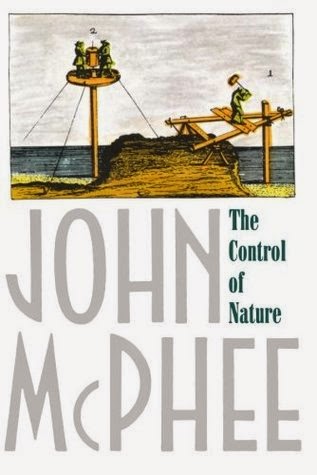
Sure, there are anecdotal tales of people locked in a struggle for their very survival against nature; three of which are explored in John McPhee’s book, The Control of Nature. At the end of the day, the forces of this planet (and beyond) far out power, outclass and outweigh humanity’s power.  It’s no contest.

Image: The Control of Nature by John McPhee book cover

What this humanity must try and comprehend is that we are a part of the planet and of nature, much like any organ is a part of a larger organism; every organism is a part of a larger ecosystem.

If any of our cells begin to exhibit behaviour which attempts to usurp the authority of the body to regulate and maintain optimum stasis for itself, those cells are attacked by the immune system. We call such behaviour cancerous. If it’s a foreign body, we call it infection.

Truly, how else can humanity’s attempt to control the world via geo-engineering be seen as anything other than a cancer? This is not adaptation; evolution; or any other euphemism the scientific community—or those in power who fund their research—can muster up in defense of their actions.

Simply put, it’s an attempt to continue a different kind of insanity which infects the psyche of our ill-fated humanity: the irrational belief that we can keep on doing the same thing we’ve always done and get away with it.

Imagine the insanity of such beliefs being endorsed, promoted and facilitated by so-called objective, rational science? That somehow, although stars and planets themselves die, we can find a way to cheat death, manipulate and fundamentally alter our host planet (regardless of the consequences for other beings on it), and “keep the party going”…with our favourite game, money and power, intact.

In the Hindu tradition, Divine Mother Nature can manifest herself in one of three possible ways. One being Kali, Destroyer of Worlds.

Image: Kali, Goddess of Destruction 

It is time for those with power and money, the ones desperate to hold onto it (and grow it), to comprehend that myth or no myth, the reality embodied by the sacred symbology of Kali is all around us, and that there is no technology born of infinitesimally small intellect that can stop the singular, relentless destructive potential of nature, any more than technology can cheat death.

Why not? Because both death and destruction are essential to the very mechanism and success of life itself! The other “versions” of Mother Nature are birth and sacrifice (that is, giving rise to new life from the primordial womb of nature and sustaining said life by sacrificing the body of nature).

Notice how “wealth and power” are simply not part of the equation; neither will chemtrails and geo-engineering ever be. Try as they might, the power-mad and money-hungry cannot and will not succeed.

But not before they cause a good deal more problems for all of us. It’s just another reason why Genesis Eco Fund’s mandate of promoting indoor ecosystems is so important. We just can’t continue counting on the traditional environment “out there” to provide for us and support us, not when Mother Nature has madmen and their science insane geo-economic manipulations to contend with.

Watch the full film here:

Video: "Why in the World are They Spraying?" Documentary HD 


Tuesday, May 6, 2014

Through the Eyes of an Evolutionary Biologist, Paradise is for the Birds:
Cornel Lab of Ornithology’s Project Explores New Guinea’s Birds of Paradise

VIDEO: Birds-of-Paradise Project Introduction

“The bird of paradise alights only on the hand that does not grasp.”
~ John Berry

The above quotation by John Berry perhaps sums up the sad triumph of Cornel Lab of Ornithology’s Birds of Paradise Project.

To begin, we wish to take nothing away from the tremendous dedication and sacrifice of Evolutionary Biologist Ed Scholes and Wildlife Photojournalist Tim Laman, who spent the better part of a decade trekking into the dense unforgiving jungles of New Guinea to study and document the Birds of Paradise on a scale never before attempted.

Still, we cannot help but feel deep sympathy for these two intrepid explorers and their guides who, despite obviously having a fair amount of material and technical support from a major U.S. academic institution, seem somehow desperate in their attempts to grasp what they experienced, having only the framework of evolutionary biology to work with.

Consider the Shapeshifting behaviour of Birds of Paradise:

VIDEO: Shapeshifting

In the Introduction to the Birds of Paradise Project, the questions are repeatedly asked: “How? Why?” How did these adaptations and behaviours evolve? And why only in New Guinea and nowhere else in the world? The tone in Scholes’ voice is almost pained; desperate to try to understand a riddle which his lifetime-developed and indoctrinated paradigm is hard-pressed to answer. And yet, he has no choice but to force his theories into Darwin’s framework. Laboured, and somewhat comical, like trying to cram a dozen clowns into a VW Beetle—tragic, when you stop thinking about it and observe it for what it is.

Here’s a segment on Dance behaviours of Birds of Paradise:

VIDEO: Dance

The term used by evolutionary biologists is Speciation. It is a term that is believed to have been coined by biologist Orator F. Cook (Source: wikipedia.org: Speciation). We take it to be an updated expression of Darwin’s famous “Origin of Species,” although speciation itself refers to specific modalities of so-called “natural selection.”

Now, it is obvious that evolution is a real mechanic of nature within species. It is obvious that species change over time and that new species do, in fact, appear. However, to assume that evolution is the only way for new—and especially complex and particularly spectacular species and behaviours—to appear is close-minded and grossly limiting.   

Meet all 39 species of New Guniea’s Birds of Paradise for yourself and decide if all are just products of random evolutionary events:

VIDEO: 39 Species

The point we are making is that a deep appreciation of nature takes place not in the cold rationalizations of a logical intellect—which wants to reduce all of nature to a mechanical clockwork, and occurrences within nature to random chance—but in the expansive and warm comprehensions of the heart.

Where the intellect’s capabilities end, the intuition’s begin. There is a knowing that is possible without thinking, and it is in this place of none-thought that true Paradise can be perceived—directly, unobstructed by the incessant chattering, squabbling, contradicting thoughts of a conditioned ego- intellect.

The truth is neither this nor that; neither A nor B, nor even A+B. Theories are not reflections of reality, and even measurements are only a shadow of what is actually there. Reality is more subtle than all that. Too subtle, in fact, for the crude materialistic intellect. This is simply a statement of fact.

All struggles of materialist scientists bumping against the glass ceiling of their field—be it evolutionary biology, theoretical physics, quantum theory, and certainly human physiology and psychology—is an expression of this phenomenon: the universe is not definable in materialist scientific terms.  Nature is not cold and mechanical. It simply isn’t. If it were, how could it inspire the heart? The evolution we observe is the crudest shadow of real, authentic evolution…

To comprehend the real nature of things requires a completely different kind of evolution: it requires true human evolution…us to evolve into true human beings. That evolution is a revolution…a revolution of consciousness. Sadly for the Birds of Paradise of New Guinea, their true nature and supreme intelligentsia will go on completely unknown to modern science. And the brilliant circumstances of their true origin will elude this humanity for some time to come.

Anyone who spends any length of time with an open mind—an empty cup—in the company of an ecosystem, will have an opportunity to access the true, conscious and 100% non-mechanical origin of species; when one moves beyond the origin of species and into the origin of experience itself.

Perhaps we should let the Birds of Paradise speak for themselves:

Video: Sound: and the Birds-of-Paradise


Tuesday, April 22, 2014

EARTH DAY REFLECTION 2014: the Mechanical Approach versus True Sustainability
Live Life Consciously in Harmony with Nature; Your Earth & the Whole Planet are Reborn!

Image by Genesis Eco Fund: Earth Day 2014 Reflection: Mechanical Approach v.s. Sustainable Approach

“A mechanical, systems-based approach can only produce more exploitation because its foundation is separation. True sustainability emerges when we consciously embrace an ecosystems-based approach.”
~ Wolfgang Amelung, Inventor & Co-Founder of Genesis EcoFund
Every Earth Day it’s the same thing: the world expounds in the virtues and necessities of saving the planet, and they point to the perils and evils of one kind of technology, while gushing over the benefits and glories of a different brand of technology, all the while missing the point entirely.

To truly comprehend the meaning of “Earth Day,” we must begin to comprehend that “the earth” has always had a second meaning as it applies to humanity. While this meaning is not exactly “hidden” in the strictest sense, it has been lost on most people.

“Earth” is another word for “soil;” the hume in the word hummus (a very “earthy” substance indeed); that is the stuff; earthstuff, if you will…the flesh of the earth. This sense of the word applies to the hume in human. In truth, the word human is a compound word meaning earth and mind (hume and manas).

Image: Earth, Hands  
Source: breisebreiseleighgoleire1969.wordpress.com: Breise! Breise! Extra! Extra!: News Headlines from around the world Septmber 11th 2011

In a very real sense, when we think about Earth Day, we should not avoid thinking of ourselves. 

But we do. We see ourselves as somehow separate from the earth when in truth, we are the earth; it is us. This is both a physical and metaphysical phenomenon: it is a reality in every sense and at every level.  It is not the whole truth, but it is far closer to the complete picture than modern science (or even contemporary religion, for that matter) comprehends.

And therein lies the problem. We separate ourselves into a distinct category (human world v.s. the natural world). We believe ourselves to be lords over nature: that it somehow is ours to do with as we please; subject to any and every monstrosity our mechanical minds can conceive of.

What we call progress and civilization, built on so-called human ingenuity and technology, has been at the expense of the earth; of nature; and our fundamental nature as earth! Our relationship with the planet is directly 1:1 analogous to our relationships with ourselves and each other.

Production, consumption, construction, destruction, addiction, affliction, subjugation, medication…anxiety, stress, SUFFERING.

And what’s our response? To continue the insanity, as Albert Einstein described it; that is, doing the same thing over and over and expecting a different result.

Humanity believes so-called advanced technology—the same old linear, binary, mechanical systems-based approach made more complicated and sophisticated—will save it.  Economists actually believe they can achieve perpetual growth by returning indefinitely to the wellspring of efficiency.

All it takes is a conscious, honest, objective look within oneself and any and all of nature on this planet and in the vast expanse of the universe to know the utter tragicomedy of modern humanity’s thinking…nothing in the physical universe lasts forever: not even planets, stars or galaxies

So what’s the Answer?

It’s quite simple, really. We advance with a conscious appreciation of authentic nature. We throw away the crude linearity of a binary existence—the legacy of our mechanical systems-based approach—and embrace the infinite complexity of an ecosystems approach.

Instead of imposing a mechanical bias on nature (which is a crude and superficial understanding at best) and subjecting it to the unspeakable horrors such cold, heartless calculations create in the real world, we expand our consciousness and with objectivity embrace the reality of nature…ecosystems.

Only nature can create authentic sustainability. And even then, we must acknowledge and accept that the cycles of birth, death and sacrifice are fundamental to the nature of all things—ourselves, our civilization, and our planet is no exception.

The beauty is, once you start embracing an ecosystems approach—once you immerse yourself in the electromagnetic field of an indoor ecosystem and open your consciousness to your participation in it and relationship with it—you settle into the unavoidable laws of the universe…comprehension follows.

By comprehension we mean a deep, conscious appreciation and direct experience of the nature of yourself and all things; this is not an intellectual pursuit, and cannot be achieved by reading books or any other intellectual means. However, it can and must be experienced for real personal growth.

And, as it turns out, conscious comprehension and direct experience of the nature of ourselves and all things is the birthright of humanity, the dream of every living being, and represents the real “progress” and true sustainability for our individual earth, and the planet as a whole. 

This is the mission of Genesis Eco Fund, and our hope for you and the whole planet from this Earth Day forward.

To look at all this in a slightly different way, contemplate the following quotation which has been attributed to Chief Seattle, although according to Barefoot Windwalker it is neither “historically accurate, nor even something that Chief Seattle said” regardless…

“This we know: the earth does not belong to man, man belongs to the earth. All things are connected like the blood that unites us all. Man did not weave the web of life, he is merely a strand in it. Whatever he does to the web, he does to himself.”
~ Chief Seattle
Source: barefootsworld.net: CHIEF SEATTLE'S LETTER
Image: Quote by Chief Seattle, “This we know: the earth does not belong to man…” 
Source: www.plentifulplanet.com

Related Links:
Earth Day Canada
Earth Day Network
PeapodLife


Thursday, March 27, 2014

The Mad Science of Chemtrails, GEO Engineering & Global Climate Experimentation

Published by Alex Alexander

Before we get into the contents of the above video, consider the following quotation and its source/backstory…
"It's an experimental cooking fuel, a derivative of butane," said [Orlando Fire Assistant Chief Rich Wales] "It did have a catastrophic failure of the cylinder that caused the explosion and the partial collapse of the building."
~ Orlando Fire Assistant Chief Rich Wales, on the September 26th, 2013 downtown Orlando Explosion at a building owned by Aaron Fechter, an inventor who once co-owned the Showbiz Pizza chain; also credited with inventing the game Whac-A-Mole.
Source: clickorlando.com: Click Orlando > News > Explosion wrecks downtown Orlando building

Now, hyperbole and Hollywood ideas about the dreaded “mad scientist” aside, it doesn’t take a lot of common sense to know that Murphy’s Law (If anything can go wrong, it will) is a real phenomenon when it comes to scientific experiments, especially ones—it seems—involving chemicals.

An August 2010 article in Scientific American boasted: Danger in School Labs: Accidents Haunt Experimental Science, but could offer no statistics because “No hard numbers exist on how often such incidents occur in labs because no one tracks them as a distinct category.”

Well, statistics aside, I think it can be said in this case that anecdotal evidence sufficiently tells the tale of humanity’s ill-fated capacity to handle its chemicals.

And just to be clear: we’re not referring to experiments as one might expect them: in “safe, controlled, contained laboratory environments.” No, we mean those “mainstream, industrialized, everyday mundane, out in the real world” kind of science experiments that aren’t considered experiments at all. 

Wikipedia offers a useful survey of some of the major industrial disasters to befall the world since the Halifax Explosion of December 6, 1917. Here are just a few chemical-related industrial disasters.
  • 1932-1968: The Minamata disaster was caused by the dumping of mercury compounds in Minamata Bay, Japan. The Chisso Corporation, a fertilizer and later petrochemical company, was found responsible for polluting the bay for 37 years. It is estimated that over 3,000 people suffered various deformities, severe mercury poisoning symptoms or death from what became known as Minamata disease.
  • 1948: A chemical tank wagon explosion within the BASF's Ludwigshafen, Germany site caused 207 fatalities.
  • February 3, 1971: The Thiokol-Woodbine Explosion at a Thiokol chemical plant in Georgia killed 29 people and seriously injured 50.
  • June 1, 1974: Flixborough disaster, England. An explosion at a chemical plant near the village of Flixborough killed 28 people and seriously injured another 36.
  • July 10, 1976: Seveso disaster, in Seveso, Italy, in a small chemical manufacturing plant of ICMESA. Due to the release of dioxins into the atmosphere and throughout a large section of the Lombard Plain, 3,000 pets and farm animals died and, later, 70,000 animals were slaughtered to prevent dioxins from entering the food chain. In addition, 193 people in the affected areas suffered from chloracne and other symptoms. The disaster lead to the Seveso Directive, which was issued by the European Community and imposed much harsher industrial regulations
  • December 3, 1984: The Bhopal disaster in India is one of the largest industrial disasters on record. A runaway reaction in a tank containing poisonous methyl isocyanate caused the pressure relief system to vent large amounts to the atmosphere at a Union Carbide India Limited plant. Estimates of its death toll range from 4,000 to 20,000. The disaster caused the region's human and animal populations severe health problems to the present.
  • November 1, 1986: The Sandoz disaster in Schweizerhalle, Switzerland, releasing tons of toxic agrochemicals into the Rhine.
  • May 4, 1988: PEPCON disaster in Henderson, Nevada. Massive explosion at a chemical plant killed 2 people.
  • June 28, 1988: Auburn, Indiana, improper mixing of chemicals killed four workers at a local metal-plating plant in the worst confined-space industrial accident in U.S. history; a fifth victim died two days later.
  • May 1, 1991: Sterlington, Louisiana. An explosion at the IMC operated Angus Chemical Nitro-paraffin Plant Sterlington, Louisiana killed 8 workers and injured 120 other people. There was severe damage to the surrounding community. The blasts were heard more than 8 miles away.
  • October 4, 2010: Alumina plant accident. Ajka, Kolontár, Devecser and several other settlements, Hungary. The dam of Magyar Aluminium Zrt.'s red mud reservoir broke and the escaping highly toxic and alkaline (~pH 13) sludge flooded several settlements. There were nine victims including a young girl and hundreds of injuries (mostly chemical burns).
  • Source: wikipedia.org: Wikipedia, the free encyclopedia: List of industrial disasters

Bottom Line? Experimental or no, HUMAN BEINGS DO NOT HAVE A GOOD TRACK RECORD WHEN IT COMES TO CHEMICALS.

So, does any more really need to be said regarding chem-trails, geo-engineering with chemicals and environmental manipulation on a global scale using potentially toxic / harmful substances?

Okay, so maybe we aren’t going to blow up the planet, but how about poisoning it? Irrevocably messing it up? I bet you NO ONE ever thought Halifax Harbour could be “blowed up real good, eh” either! I bet you no one in Bhopal, India could imagine the toxic cloud poisoning millions (until after it happened).

When are scientists going to learn their lesson? Maybe they should listen to whom many see as the “classic” image of the mad scientist:
“Insanity: doing the same thing over and over again and expecting different results.”
~ Albert Einstein
Image: Albert Einstein, the Definition of Insanity. 

In all fairness, I don’t think Einstein was mad at all. Compared to what some scientists are playing with. That said, just look what scientists did—backed by government, military and economic interests—with Einstein’s theory and legwork…
Image: The mushroom cloud billowing up 20,000 feet over Hiroshima on the morning of August 6, 1945; Photo from U.S. National Archives, RG 77-AEC) Source: www2.gwu.edu: The Atomic Bomb and the End of World War II: A Collection of Primary Sources

And it’s very much the same story with chem-trails and geo engineering. Government in bed with big business (cap and trade scheme mentioned in the last few minutes of the video) to avert one disaster in favour of another.

Will we ever learn?

Insanity, indeed.

Thursday, November 21, 2013

“Imagine if Every Office Had an Ecosystem”
Wellness Professional Shares Her Thoughts on the Benefits of Ecosystems

Image: Ecosystem with Monkey Orchid

Genesis Eco Fund’s mandate to educate the public on the benefits of ecosystems is both rewarding and at times quite easy. It’s really quite amazing to witness people’s response to the ecosystem and watch as they “get it”—that is, they begin to feel the positive effects the ecosystem is having on them.

Today a friend, Lana, stopped by to see the ecosystem currently on display at 401 Richmond Street (it will be moving to 401 Bay Street and available for viewing from December 1st).

Lana works at Source Centre, “Downtown Toronto's Holistic Health and Wellness Centre” - www.sourcecentre.ca. Among various administrative duties, Lana is also an accomplished Reiki practitioner.

Upon seeing the ecosystem in person for the first time today, Lana’s initial reaction was to note how small it was. Typically, when you tell people about rainforest ecosystems, their minds conjure up images of South American jungles.

It only took a moment to point out, “the ecosystem you’re looking at is one of our smaller units; they can be scaled up to any size.”

Next she was struck by the variety of plants and how noticeably different they were from what you’d typically find in an office environment. Some of the unique roots structures and colourful flowers aside, the carnivorous flowering plants, orchids and moss clearly were clear indications of something special.

Not only was the variety of plants different, they seemed much lusher, showing greater vitality than any potted plant. Here we got into a discussion around the energy of ecosystems.

“Yeah, I can really feel how it changes the energy of the space,” Lana said. A few moments later, she added: “can you imagine if every office had an ecosystem?”

Yes, we certainly can. And with that, we discussed briefly the benefits to companies, organizations, governments, schools and society as a whole were people to be able to experience such beautiful, fresh air and soothing, relaxing vibes throughout the day.

How might working in a healing space change our perspective on the work we do, the people we work with, and the challenges we face? What sorts of new inspiration might we experience?

Genesis Eco Fund intends to explore these questions and more; documenting results and sharing the stories of all those who, like Lana, experience the benefits of ecosystems—even if only for a moment.

And, for those who really need to experience the benefits ecosystems can provide but cannot afford one, Genesis Eco Fund is determined to help them through fundraising efforts so they too can enjoy the benefits that only nature in her highest expression can provide.


Tuesday, November 5, 2013

Is Your Workplace Hurting You, Your People and Your Profits?
Expand Your Understanding of "Hostile Work Environment"

Image: Hostile Work Environment by Desolee
“A hostile work environment is created by a boss or coworker whose actions, communication, or behavior make doing your job impossible. This means that the behavior altered the terms, conditions, and/or reasonable expectations of a comfortable work environment for employees. Additionally, the behavior, actions or communication must be discriminatory in nature.”
~ Susan M. Heathfield
Source: About.com Human Resources: What Makes a Work Environment Hostile? Legal Guidelines Exist to Define a Hostile Workplace
Let’s be clear from the get-go: we are in no way shape or form belittling the gravity of the circumstances currently falling under the legal definition of hostile workplace environment. Far from it. Workplace hostility in all its forms is unfortunate, in many cases deplorable and in some cases may be avoidable.

A bold statement, we know; but please bear with us, we do have a rational case to make.

It should be pointed out that there has never been any causality established in hostile work environments. Like so many facets of human behavior it has been chalked up as “human nature” which has crossed the lines of acceptable moral codes of conduct in the workplace.

If there was such a thing as spectrum of hostility, it is reasonable to suggest people tend toward “more hostile behaviours” toward their subordinates when they are under greater stress, greater duress. It’s a kind of natural transference of negatively charged energy.

We’ve all experienced some form of being “dumped on” by another person. We are social creatures and sometimes we need to “let off some steam.” Mainstream media and the Internet is filled with so-called “rants” of people expressing a seemingly endless stream of negative—sometimes violent—emotions.

What are violent films, TV shows, sports and video games if not “socially acceptable outlets” of violent tendencies? Ways of “burning off” negative energy? Surely a boss, manager, supervisor, etc. may subconsciously perceive subordinates in the same category, where power over a subject/object signals a potential outlet for negative emotions (which, we can easily recognize as hostility).

Haven't we all let off steam at the expense of a partner, spouse, family member, friend, store clerk, waiter, or even complete stranger? 

Where does all this negative energy come from? We know from the laws of physics that matter and energy are neither created nor destroyed but endlessly transformed. Is it outrageous to suggest that the negative energy we accumulate within our psyche has its source, at least in part, in our environment?

Certainly someone who feels they are the victim of a hostile work environment will agree with this.

The hostile work environment can be a tremendous source of stress. Individuals in such circumstances may indeed find themselves going home and taking out their work frustrations on their children, spouse, pets, comfort food, sports…use your imagination and/or personal experience. We’ve all been there.

So why not the perpetrators of workplace hostility? Even CEO’s have superiors (i.e. Board of Directors, Government Regulators, in some cases the Media). They may not experience the same concentrated hostility as someone on the receiving end of their venting, but they are exposed to a great deal of constant pressure associated with their responsibilities; pressure which becomes STRESS.

Image: Possible Causes of Hostile Workplace Environments by GenesisEcoFund

The purpose of the above diagram is not to suggest the perpetrators of workplace hostility are not responsible for their actions. We're simply pointing out both the perpetrator and the victim are part of the same negatively charged environment and that what the victim experiences as a hostile work environment is a different experience of the same negatively charged environment: accumulated, focused and directed at them.

The ultimate negative impacts of such cumulative, focused and directed negative energy on a person are numerous, and include all manner of psychological and physical illness. This is both well documented and intuitive.

We should not discount the feedback mechanism and how such hostility compounds the negative environmental pressures of the workspace (at least in part “the source” of the problem).

So let us imagine the same dynamic with an indoor rainforest ecosystem:

Image: Ecosystem Causes of Productive Workplace Environments by GenesisEcoFund

A harmonious and productive environment is only the beginning. If nature has shown us anything,  it’s that the matrix of life, Ecosystems, holds within it the potential for infinite creativity, adaptability, beauty, ingenuity and resilience. Imagine the potential inspiration and problem solving should even a fraction of these qualities of ecosystems be transferred to the people working in the self-organized, positively charged microclimate.

This is simply intuitive. We look forward to conducting real-world research as part of our mandate to explore all the benefits of establishing symbiosis within workplace environments via ecosystems.