Thursday, July 31, 2014

“We Are from the Future” has some Interesting Ideas about Plant Photosynthesis

Video: “We are from the Future” by Upriser
“plants harvest light with near perfect efficiency, but this is impossible under classical physics”
The message on WeAreFromTheFuture.com looms ominously, complete with a countdown timer:

“TIME LEFT UNTIL OUR NEXT MESSAGE: 6 DAYS | 10 HOURS | 19 MINUTES | 13 SECONDS”

But far from a kind of doomsday clock, this website (and subsequent video “message,” above) is more like a “threat of positivity” (if there is such a thing).

As Al Qaeda and others release videotaped messages periodically, laying down their plans, manifestos, etc., the group behind Upriser.com appears to be doing something similar. Similarly subversive, albeit with far less blatant violence, hatred, and calls for bloodshed against any identifiable “enemy.”

But it works. We prefer the first half of the video, with the soundtrack provided by Hans Zimmer; but, we recognize how the second half speaks to a different—possibly younger and/or more “hip”—audience. (Gosh, are we that old!?)

Image: Screenshot, We Are From the Future Countdown 

But the purpose of sharing this video today is to discuss what appears to be one of the main thrusts of its message: light; specifically, how plants convert it to energy via photosynthesis with near perfect efficiency.

We all studied photosynthesis in high school (don’t roll your eyes: you did too, even if you were half asleep or scribbling love notes to your high school crush at the time). But the video makes an interesting argument: how is it that plants are able to use light so efficiently, when the laws of physics more or less prohibit it? The answer, as it turns out, comes from some actual quantum theory:
"Energy transfer in light-harvesting macromolecules is assisted by specific vibrational motions of the chromophores," said Alexandra Olaya-Castro (UCL Physics & Astronomy), supervisor and co-author of the research. "We found that the properties of some of the chromophore vibrations that assist energy transfer during photosynthesis can never be described with classical laws, and moreover, this non-classical behaviour enhances the efficiency of the energy transfer." "The negative values in these probability distributions are a manifestation of a truly quantum feature, that is, the coherent exchange of a single quantum of energy," explained Edward O'Reilly (UCL Physics & Astronomy), first author of the study. "When this happens electronic and vibrational degrees of freedom are jointly and transiently in a superposition of quantum states, a feature that can never be predicted with classical physics."
Credit: ucl.ac.uk: UCL News: Quantum mechanics explains efficiency of photosynthesis Source: http://upriser.com/posts/we-are-from-the-future
Now, at Genesis Eco Fund, we’re all about the cutting edge quantum mechanics, especially as it attempts to explain the incredible power of plants. We wonder, however, if this isn’t a good time to bring up consciousness.

Many of the proponents of consciousness often bring up quantum mechanics and the so-called observer effect (that the very act of observation of a particular quantum particle changes its state or behavior versus non-observation of it).

Any connection in the “consciousness field” overrides classical physics. Of course, because consciousness is not a product of material reality. Consciousness is primary (as we have discussed and shared before). Here’s an abridged reminder:

Video: The Primacy of Consciousness (Excerpted) 

So what does this all mean?

Consciousness, as we know (or rather, should know) has qualities. Conscience is one of them. Imagination, superior intelligence (the superior intelligence of knowing without thinking; without reason—but not necessarily without observation or imagination) are others.

Plants have consciousness. And so does light. And because both light and consciousness are not a part of the physical universe (the three dimensional plane) but of more subtle levels of reality (the superior dimensions), they do not abide by the laws of physical nature. In this way, physical materialist science (classical physics) breaks down and we get the observations of quantum mechanics.

But that’s all they are: observations. The quantum theory is where it all breaks down because consciousness isn’t mechanical. Consciousness is, well, conscious! And because it is, trying to figure it out with something so primitive as the human intellect will not work.

It is through profound introspection and meditation—cultivation of consciousness itself—that increases our ability to comprehend on levels past the sensory and rational materialistic physical intellect.

It is on these superior levels of conscious interaction that ecosystems operate. They are not mechanical entities, but rather self-regulating super-organisms whose harmony and symbiosis are organized in consciousness—not the level of material reality which we observe.

“By faith we understand that the worlds were prepared by the word of God, so that what is seen was not made out of things which are visible.”
~ Hebrews 11:3 

If we understand the symbol of “the word of God” as sound—vibration (frequency)—now things begin to make sense again, including from a quantum perspective. And, we can understand how the light can reach the “core”…as far as light is concerned, there is no “mindless matter” to run into.

Thursday, July 24, 2014

Do Trees Communicate?
Ecosystems & the Communication of Plants

YouTube Video: Do trees communicate; published by A Future of OUR Choosing 
Source: YouTube: http://youtu.be/iSGPNm3bFmQ

"Nature is not mute, it is a man who is deaf."
– Terence McKenna

In our last blog post about education, we stated that Darwin’s axiom of “survival of the fittest” was a gross oversimplification, and a flawed view of nature as a collection of individuals. We know it is not.

Image: New Scientist Cover: Darwin was Wrong

The above video is further evidence that not only are ecosystems infinitely complex, they are also highly advanced and sophisticated, complete with intercommunications using various species as means to send important information across vast distances.
“In this real-life model of forest resilience and regeneration, Professor Suzanne Simard shows that all trees in a forest ecosystem are interconnected, with the largest, oldest, "mother trees" serving as hubs. The underground exchange of nutrients increases the survival of younger trees linked into the network of old trees. Amazingly, we find that in a forest, 1+1 equals more than 2.”

We know planets react to light, smell, sound, movement, many kinds of aesthetic stimuli. But although these reactions have not resulted in the conclusion “plants are conscious” in mainstream science, the observation that plants communicate across the forest using species other than themselves to send signals and messages—however rudimentary in nature—shows a specific quality: altruism.

Altruism is a quality of consciousness. Altruism is not a self-preservation instinct, even if it is triggered by an immediate threat to oneself. From this video, we see that trees look out for one another, a trait normally only associated with animals. 

But if trees and fungi work together as described, what may be happening elsewhere in the ecosystem? In much the same way that our bodies communicate in complex and intricate ways, it can be said that ecosystems are “superorganisms.”

Nature is a highly sophisticated and infinitely complex series of ecosystems, all working in tandem and mutual symbiosis. We may one day discover that whole planet is an ecosystem (if we survive that long).

If so, we will discover that the planet is not a “superorganism” but a “megaorganism.”

Image: Planet as “Megaorganism” 


Tuesday, July 15, 2014

What Role can Ecosystems Play in Changing Education Paradigms?

Video: RSA Animate - Changing Education Paradigms; 
Credit: RSA Events; Sir Ken Robinson www.theRSA.org in Accordance with RSA Policy Statement 

“If the misery of our poor be caused not by the laws of nature, but by our own institutions, great is our sin.”

We at Genesis Eco Fund are very much concerned with the issue of education, but not in the trite, cliché treatment it normally receives: by parents, teachers, employers and—worst of all—politicians and bureaucrats.

Genesis Eco Fund concerns itself with the machinery of education (that is, what it has become). Not just “the education system” as it were, and certainly not “the institution of education.” Rather, the unquestioned assumptions regarding the institutionalization of education as a matter of natural course.

With that in mind, we share the above video by RSA Animate featuring a talk by Sir Ken Robinson (about the need to reimagine the paradigm of institutionalized education as we know it (as some kind of “natural” phenomenon). Not least in the light of the quote by Charles Darwin.

Image: Charles Darwin Quote on Slavery, “If the misery of our poor be caused not by the laws of nature…” (1836)  
Source: todayinsci.com: TODAY IN SCIENCE HISTORY: Charles Darwin Quote on Slavery (1836)

The fact is, the “emerging problems” of education are, in-fact, inherent in the underlying myth that the institutionalization of the current system is natural. It is not at all natural; it is, as Ken Robinson points out, a myth!

What else unnatural, Mr. Robinson goes on to say, is the current paradigms’ lack of recognition that “most great learning happens in groups,” that is to say “collaboration is the stuff of growth; and, that the current educational model of atomizing and judging people separately, we “form a kind of disjunction between them and their natural learning environment.”

This statement could easily describe ecosystems. What is collaboration after all? Collective harmony and mutual symbiosis…the modus operendi of ecosystems. So what about the apparent competition of said ecosystem? What of our friend Darwin’s famous axiom “survival of the fittest”?

Ironically Social Darwinism (very prominent when the current educational paradigm was established) is to blame for the insistence on standardized testing and pitting individuals against one another. But this is inherently counter-productive to the collaboration just mention; and, as it turns out, is ultimately a bit-player in the functioning of ecosystems!

In other words, survival of the fittest may be a natural phenomenon, but human beings have placed far too much emphasis on it and not the more fundamental law of nature: harmony and symbiosis. Survival of the fittest as “understood” by Darwin and everyone since is an ego-projection. Darwin found a phenomenon in nature which provided him with a reasonable theory to explain “the origins” of our linear, intellectual, reactionary experience of conflict (personal, tribal, social, national, etc).

The problem is, Darwin didn’t see the bigger picture. He saw organisms only in isolation according to classical definitions of human conflict (man vs. man, man vs. nature): individual vs. individual, pack vs. pack, individual and/or pack vs. nature. Darwin didn’t see ecosystems; he certainly never stopped to recognize that ecosystems are “super organisms” (that evolve, have interests, etc).

Competition (testing of individuals against each other, the environment, etc.) is part of the constant balancing inherent in symbiosis and harmony, just as any collaborative group encounters conflicts and conflict resolution as the inevitable differences and competing interests of individual are integrated into the whole collaborative effort. And yes, struggle and death are a part of life, but not according to some linear equation, or massive “us versus them” oversimplification as experienced by human ego-intellect!

In other words, individuals have clearly defined personal goals, but in a successful collaborative effort (sports team, business, etc.), individual goals are aligned into the collective goal, such that cooperation trumps competition by far! This is how nature really works…ECOSYSTEMS!

Example: many “favourites” for this year’s world cup had “superstar” players whose individual interests included “showing their nation and the world they are deserving of such praise and adoration.” Germany had a solid team of players whose individual interests were aligned with the collective interests. How often we saw German players in position to “go for glory” instead pass the ball to a teammate in a much better position to get a goal—and pass and score Germany did. And the results speak for themselves.

Image: “There is no “I” in “team” Germany 2014 

And then at 11:00 minutes into the talk, Sir Ken drops this bombshell:

“It’s about the habits of our institutions and the HABITATS THEY OCCUPY.”

The very presence of ecosystems in an institution changes the habitat of that institution. One CANNOT occupy an ecosystem and not be a part of it. One cannot be a part of an ecosystem and not experience an alignment of one’s individual goals with those of the collective.

This alignment is bi-directional. In other words, just as your habits change to align with the habitat, the ecosystem adjusts to accommodate your goals.

Example: Germany had solid players: Klosse, who became the winningest player in world-cup history, for instance. But the culture of collaboration meant he didn’t “go for glory.” He was just another equal member of the team.  He wanted to win. His team wanted to win. He probably did want to break the record, but his personal success was secondary to his team’s success. In the end, that formula for success allowed him to indeed accumulate the goal count he was looking for…but not at the expense of his ecosystem.

Example: let’s say you want to be healthy, happy, peaceful, etc. The ecosystem also seeks harmony and healthy—optimal levels of performance for all its members. There is a clear and obvious alignment.

But what if you are a smoker? Sure, you want to be healthy, but you just can’t break this habit which relaxes you? In the short run, the ecosystem will synthesize bacteria to break-down tar and nicotine in the air. Over time, your presence in the habitat of clean air, positive energy, and natural calming power of nature will reduce your need to turn to cigarettes. Our habitat affects our habits. Plain and simple.

Image: Stillframe from Video: RSA Animate - Changing Education Paradigms; 
“The habits of our institutions and the habitats they occupy…” 
Credit: RSA Events; Sir Ken Robinson www.theRSA.org in Accordance with RSA Policy Statement

So, too then, with the institution of learning. And let’s face it, one look at an ecosystem and one realizes that lateral, divergent thinking, inspiration, imagination, and all the wonderful preconditions for real creativity are all there…naturally. Truly.

And that’s all just the tip of the iceberg of how ecosystems can change any institution, especially education (which is, let’s face it, supposed to be all about GROWTH). If education is all about growth, then the ONLY model, the ONLY paradigm that will ever work is THE TRULY natural, effective and proven model for growth: ecosystems. Here we coin the phrase: “Survival of the most fitting?”

Tuesday, June 10, 2014

When an Ecological Political Cartoon Becomes High Art

Image by Pawel Kuczynski (Poland) - Niels Bugge Cartoon Award 2014

“I think that high art reposes on popular art, without one there cannot be another.”
~ Eric Rohmer
Source:  BrainyQuote - Eric Rohmer - High Art Quotes
Today we are going to offer something rather different. While it can be said that ecosystems have an inherent beauty & truth, as does all of nature, today we are going to look at political cartoons about nature—and our relationship with it—and see if something akin to universal truth & beauty.
“Human being, as all life on earth, came from the stars and landed through the ocean. Ocean is our very first foster mother, much more than the land where we, now, cut trees and plant transgenic corn. But, as we maltreat land, we have been maltreating our spring of life and now oceans are quite ill because of our activities: less fish but more plastic, less pure water but more oil, less coral but more garbage.”

Thus went the challenge issued to cartoonists and illustrators by the Niels Bugge Cartoon Award. Participants from 75 countries submitted their works, both satirical and some unquestionably artistic.

As reported by The Huffington Post, “the international competition received over 1,000 entries, sent from everywhere from Iran, China, Syria, the U.S. and the host country, Denmark.”

Here ‘s what Canada’s own Bruce Mackinnon had to share.

Image by Bruce Mackinnon (Canada)  - Niels Bugge Cartoon Award 2014

And, we quite agree with their assessment that the political cartoons “seem to perfectly unfold the issue of climate change, encapsulating the issues and feelings wrapped up in discussions of humans' impact on our planet.” Source: Huffington Post

We’ll go one better. At least one of the finalists’ submissions transcends mere political commentary and ascends to heights of universal truth and beauty…unquestionably attaining the status of high art.

Image by Andrei Popov (Russia) - Niels Bugge Cartoon Award 2014

Far be it from us to tell you, dear reader, which one(s) achieve such lofty heights. Let’s just say you know which are our favourites (with the cream rising to the top) in our humble opinion.

Image by Shahram Rezaei (Iran) - Niels Bugge Cartoon Award 2014

But who don’t you judge for yourself? See all nine of the finalists here at:  http://www.huffingtonpost.com/2014/06/07/niels-bugge-cartoon-award_n_5455509.html .

Then, just for fun, you can compare YOUR FAVOURITES with what the official jury decided!...
http://www.nielsbuggeaward.org/

And if that’s not amusement enough for you, check out even more entries in the Nielsbugge Award Catalogue!...
http://www.nielsbuggeaward.org/catalogue2014.pdf

Tuesday, May 27, 2014

The Voracious Economics of Chemtrails, GEO Engineering & Global Climate Manipulation

Video: "Why in the World are They Spraying?" Official Trailer 
Source: YouTube video by Truthmediaproduction 

“The Filmmakers are encouraging everyone who purchases a DVD
to make copies and hand them out for free.”


As luck would have it, we have come across a film, Why in the World are They Spraying? —official trailer, above—which warrants an update to the previous blog we wrote on the subject back in March, The Mad Science of Chemtrails, GEO Engineering & Global Climate Experimentation.

In our article, we described in general what chemtrails and geo engineering are, and explored why we considered this global experiment to be, quite frankly, an exercise in insanity (in keeping with this humanity’s history of ignoring Murphy’s Law and creating disasters of all shapes and sizes).

As it turns out, Why in the World are They Spraying is likewise an update to a previous film, What in the World are They Spraying? 

Without revealing any spoilers, it’s not outrageous to arrive at the simple conclusion that geo-engineering via chemtrails and/or other means is climate manipulation for the sake of basic economic and geo-political gain.

The same old game: Money and Power.

Cartoon: Democratic Power Trumped by Economic Power  By David Fitzsimmons, Arizona Daily Star, Cagle Cartoons  
Source: mediagallery.usatoday.com: David Fitzsimmons cartoons


We chose the above cartoon for the obvious reason that in this particular case, power falls from the sky. The premise is quite simple, really: if you control the weather, you control the planet.

Now, Genesis Eco Fund is no place to discuss what are dismissed as “conspiracy theories.” It’s a simple statement of fact. Whoever manages to control the world’s weather can, in fact, enact such power over the fate of nations and their peoples, that they will effectively control the world.

BUT THERE’S A CATCH…WE THINK YOU MAY HAVE HEARD OF HER…MOTHER NATURE.

If, in our last blog on the subject, we emphasized Murphy’s Law and the Achilles heel of our irrational yet persistent belief that we are masters of the consequences of our scientific and technological pursuits, then it’s worthwhile observing our track record at “Lording over Nature.”

While on the surface it may appear, one might argue, that 20th and 21st Century humankind has advanced in leaps and bounds in our ability to control and manipulate nature, the fact remains that humanity’s controlled impact is negligible.

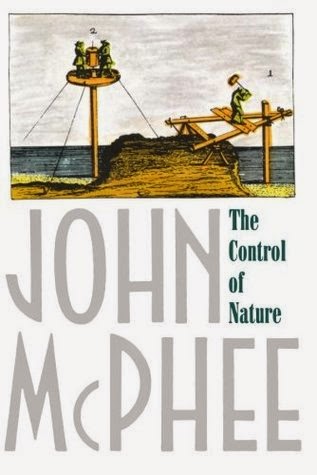
Sure, there are anecdotal tales of people locked in a struggle for their very survival against nature; three of which are explored in John McPhee’s book, The Control of Nature. At the end of the day, the forces of this planet (and beyond) far out power, outclass and outweigh humanity’s power.  It’s no contest.

Image: The Control of Nature by John McPhee book cover

What this humanity must try and comprehend is that we are a part of the planet and of nature, much like any organ is a part of a larger organism; every organism is a part of a larger ecosystem.

If any of our cells begin to exhibit behaviour which attempts to usurp the authority of the body to regulate and maintain optimum stasis for itself, those cells are attacked by the immune system. We call such behaviour cancerous. If it’s a foreign body, we call it infection.

Truly, how else can humanity’s attempt to control the world via geo-engineering be seen as anything other than a cancer? This is not adaptation; evolution; or any other euphemism the scientific community—or those in power who fund their research—can muster up in defense of their actions.

Simply put, it’s an attempt to continue a different kind of insanity which infects the psyche of our ill-fated humanity: the irrational belief that we can keep on doing the same thing we’ve always done and get away with it.

Imagine the insanity of such beliefs being endorsed, promoted and facilitated by so-called objective, rational science? That somehow, although stars and planets themselves die, we can find a way to cheat death, manipulate and fundamentally alter our host planet (regardless of the consequences for other beings on it), and “keep the party going”…with our favourite game, money and power, intact.

In the Hindu tradition, Divine Mother Nature can manifest herself in one of three possible ways. One being Kali, Destroyer of Worlds.

Image: Kali, Goddess of Destruction 

It is time for those with power and money, the ones desperate to hold onto it (and grow it), to comprehend that myth or no myth, the reality embodied by the sacred symbology of Kali is all around us, and that there is no technology born of infinitesimally small intellect that can stop the singular, relentless destructive potential of nature, any more than technology can cheat death.

Why not? Because both death and destruction are essential to the very mechanism and success of life itself! The other “versions” of Mother Nature are birth and sacrifice (that is, giving rise to new life from the primordial womb of nature and sustaining said life by sacrificing the body of nature).

Notice how “wealth and power” are simply not part of the equation; neither will chemtrails and geo-engineering ever be. Try as they might, the power-mad and money-hungry cannot and will not succeed.

But not before they cause a good deal more problems for all of us. It’s just another reason why Genesis Eco Fund’s mandate of promoting indoor ecosystems is so important. We just can’t continue counting on the traditional environment “out there” to provide for us and support us, not when Mother Nature has madmen and their science insane geo-economic manipulations to contend with.

Watch the full film here:

Video: "Why in the World are They Spraying?" Documentary HD 


Tuesday, May 6, 2014

Through the Eyes of an Evolutionary Biologist, Paradise is for the Birds:
Cornel Lab of Ornithology’s Project Explores New Guinea’s Birds of Paradise

VIDEO: Birds-of-Paradise Project Introduction

“The bird of paradise alights only on the hand that does not grasp.”
~ John Berry

The above quotation by John Berry perhaps sums up the sad triumph of Cornel Lab of Ornithology’s Birds of Paradise Project.

To begin, we wish to take nothing away from the tremendous dedication and sacrifice of Evolutionary Biologist Ed Scholes and Wildlife Photojournalist Tim Laman, who spent the better part of a decade trekking into the dense unforgiving jungles of New Guinea to study and document the Birds of Paradise on a scale never before attempted.

Still, we cannot help but feel deep sympathy for these two intrepid explorers and their guides who, despite obviously having a fair amount of material and technical support from a major U.S. academic institution, seem somehow desperate in their attempts to grasp what they experienced, having only the framework of evolutionary biology to work with.

Consider the Shapeshifting behaviour of Birds of Paradise:

VIDEO: Shapeshifting

In the Introduction to the Birds of Paradise Project, the questions are repeatedly asked: “How? Why?” How did these adaptations and behaviours evolve? And why only in New Guinea and nowhere else in the world? The tone in Scholes’ voice is almost pained; desperate to try to understand a riddle which his lifetime-developed and indoctrinated paradigm is hard-pressed to answer. And yet, he has no choice but to force his theories into Darwin’s framework. Laboured, and somewhat comical, like trying to cram a dozen clowns into a VW Beetle—tragic, when you stop thinking about it and observe it for what it is.

Here’s a segment on Dance behaviours of Birds of Paradise:

VIDEO: Dance

The term used by evolutionary biologists is Speciation. It is a term that is believed to have been coined by biologist Orator F. Cook (Source: wikipedia.org: Speciation). We take it to be an updated expression of Darwin’s famous “Origin of Species,” although speciation itself refers to specific modalities of so-called “natural selection.”

Now, it is obvious that evolution is a real mechanic of nature within species. It is obvious that species change over time and that new species do, in fact, appear. However, to assume that evolution is the only way for new—and especially complex and particularly spectacular species and behaviours—to appear is close-minded and grossly limiting.   

Meet all 39 species of New Guniea’s Birds of Paradise for yourself and decide if all are just products of random evolutionary events:

VIDEO: 39 Species

The point we are making is that a deep appreciation of nature takes place not in the cold rationalizations of a logical intellect—which wants to reduce all of nature to a mechanical clockwork, and occurrences within nature to random chance—but in the expansive and warm comprehensions of the heart.

Where the intellect’s capabilities end, the intuition’s begin. There is a knowing that is possible without thinking, and it is in this place of none-thought that true Paradise can be perceived—directly, unobstructed by the incessant chattering, squabbling, contradicting thoughts of a conditioned ego- intellect.

The truth is neither this nor that; neither A nor B, nor even A+B. Theories are not reflections of reality, and even measurements are only a shadow of what is actually there. Reality is more subtle than all that. Too subtle, in fact, for the crude materialistic intellect. This is simply a statement of fact.

All struggles of materialist scientists bumping against the glass ceiling of their field—be it evolutionary biology, theoretical physics, quantum theory, and certainly human physiology and psychology—is an expression of this phenomenon: the universe is not definable in materialist scientific terms.  Nature is not cold and mechanical. It simply isn’t. If it were, how could it inspire the heart? The evolution we observe is the crudest shadow of real, authentic evolution…

To comprehend the real nature of things requires a completely different kind of evolution: it requires true human evolution…us to evolve into true human beings. That evolution is a revolution…a revolution of consciousness. Sadly for the Birds of Paradise of New Guinea, their true nature and supreme intelligentsia will go on completely unknown to modern science. And the brilliant circumstances of their true origin will elude this humanity for some time to come.

Anyone who spends any length of time with an open mind—an empty cup—in the company of an ecosystem, will have an opportunity to access the true, conscious and 100% non-mechanical origin of species; when one moves beyond the origin of species and into the origin of experience itself.

Perhaps we should let the Birds of Paradise speak for themselves:

Video: Sound: and the Birds-of-Paradise


Tuesday, April 22, 2014

EARTH DAY REFLECTION 2014: the Mechanical Approach versus True Sustainability
Live Life Consciously in Harmony with Nature; Your Earth & the Whole Planet are Reborn!

Image by Genesis Eco Fund: Earth Day 2014 Reflection: Mechanical Approach v.s. Sustainable Approach

“A mechanical, systems-based approach can only produce more exploitation because its foundation is separation. True sustainability emerges when we consciously embrace an ecosystems-based approach.”
~ Wolfgang Amelung, Inventor & Co-Founder of Genesis EcoFund
Every Earth Day it’s the same thing: the world expounds in the virtues and necessities of saving the planet, and they point to the perils and evils of one kind of technology, while gushing over the benefits and glories of a different brand of technology, all the while missing the point entirely.

To truly comprehend the meaning of “Earth Day,” we must begin to comprehend that “the earth” has always had a second meaning as it applies to humanity. While this meaning is not exactly “hidden” in the strictest sense, it has been lost on most people.

“Earth” is another word for “soil;” the hume in the word hummus (a very “earthy” substance indeed); that is the stuff; earthstuff, if you will…the flesh of the earth. This sense of the word applies to the hume in human. In truth, the word human is a compound word meaning earth and mind (hume and manas).

Image: Earth, Hands  
Source: breisebreiseleighgoleire1969.wordpress.com: Breise! Breise! Extra! Extra!: News Headlines from around the world Septmber 11th 2011

In a very real sense, when we think about Earth Day, we should not avoid thinking of ourselves. 

But we do. We see ourselves as somehow separate from the earth when in truth, we are the earth; it is us. This is both a physical and metaphysical phenomenon: it is a reality in every sense and at every level.  It is not the whole truth, but it is far closer to the complete picture than modern science (or even contemporary religion, for that matter) comprehends.

And therein lies the problem. We separate ourselves into a distinct category (human world v.s. the natural world). We believe ourselves to be lords over nature: that it somehow is ours to do with as we please; subject to any and every monstrosity our mechanical minds can conceive of.

What we call progress and civilization, built on so-called human ingenuity and technology, has been at the expense of the earth; of nature; and our fundamental nature as earth! Our relationship with the planet is directly 1:1 analogous to our relationships with ourselves and each other.

Production, consumption, construction, destruction, addiction, affliction, subjugation, medication…anxiety, stress, SUFFERING.

And what’s our response? To continue the insanity, as Albert Einstein described it; that is, doing the same thing over and over and expecting a different result.

Humanity believes so-called advanced technology—the same old linear, binary, mechanical systems-based approach made more complicated and sophisticated—will save it.  Economists actually believe they can achieve perpetual growth by returning indefinitely to the wellspring of efficiency.

All it takes is a conscious, honest, objective look within oneself and any and all of nature on this planet and in the vast expanse of the universe to know the utter tragicomedy of modern humanity’s thinking…nothing in the physical universe lasts forever: not even planets, stars or galaxies. 

So what’s the Answer?

It’s quite simple, really. We advance with a conscious appreciation of authentic nature. We throw away the crude linearity of a binary existence—the legacy of our mechanical systems-based approach—and embrace the infinite complexity of an ecosystems approach.

Instead of imposing a mechanical bias on nature (which is a crude and superficial understanding at best) and subjecting it to the unspeakable horrors such cold, heartless calculations create in the real world, we expand our consciousness and with objectivity embrace the reality of nature…ecosystems.

Only nature can create authentic sustainability. And even then, we must acknowledge and accept that the cycles of birth, death and sacrifice are fundamental to the nature of all things—ourselves, our civilization, and our planet is no exception.

The beauty is, once you start embracing an ecosystems approach—once you immerse yourself in the electromagnetic field of an indoor ecosystem and open your consciousness to your participation in it and relationship with it—you settle into the unavoidable laws of the universe…comprehension follows.

By comprehension we mean a deep, conscious appreciation and direct experience of the nature of yourself and all things; this is not an intellectual pursuit, and cannot be achieved by reading books or any other intellectual means. However, it can and must be experienced for real personal growth.

And, as it turns out, conscious comprehension and direct experience of the nature of ourselves and all things is the birthright of humanity, the dream of every living being, and represents the real “progress” and true sustainability for our individual earth, and the planet as a whole. 

This is the mission of Genesis Eco Fund, and our hope for you and the whole planet from this Earth Day forward.

To look at all this in a slightly different way, contemplate the following quotation which has been attributed to Chief Seattle, although according to Barefoot Windwalker it is neither “historically accurate, nor even something that Chief Seattle said” regardless…

“This we know: the earth does not belong to man, man belongs to the earth. All things are connected like the blood that unites us all. Man did not weave the web of life, he is merely a strand in it. Whatever he does to the web, he does to himself.”
~ Chief Seattle
Source: barefootsworld.net: CHIEF SEATTLE'S LETTER
Image: Quote by Chief Seattle, “This we know: the earth does not belong to man…” 
Source: www.plentifulplanet.com

Related Links:
Earth Day Canada
Earth Day Network
PeapodLife