Showing posts with label genesisecofund. Show all posts

Thursday, May 21, 2015

Ecosystems & Mining:
Natural Answer to Oxygen & Air Quality?

Collage by GenesisEcoFund: Could  Ecosystems Be the Answer to Oxygen & Air Quality in Mining?

Mining companies pump countless billions of cubic metres of air every year deep underground, and spend billions of dollars every year on liquid oxygen, oxygen masks, and oxygen extraction and condensing machinery.

When we began looking at the topic of oxygen, air quality and mining, we approached it primarily from the perspective of human health and safety—workers need clean air to breathe. It turns out that oxygen is an essential element in the ore extraction process—especially gold—aiding in the separation of the desired ore from the surrounding material.

So the short answer to the question, could ecosystems have some role to play in producing fresh oxygen and cleaning the air in deep mines is: we’re not sure; it really depends. On what? Many factors.

For starters, we cannot even begin to look at a pilot study with the mining industry without some kind of quantifiable figures: how much O2 is produced per X sq ft. of ecosystem? This is just a reality of trying to apply an ecosystem to an industry which is all about efficiency and exploitation (let’s face it: there is no other way to describe extraction of precious minerals from the earth).

Mining as an activity is fundamentally concerned with outputs. It has no concept of inputs—few resource extraction industries do, with the exception of some leaders in forestry which have learned the economic benefits of sustainable forestry practices (planting trees to replace the ones which were cut down). 

A mining operation will want to know how big an ecosystem they need (or how many individual ecosystem “modules”) for how many cubic feet of mine shaft per person? But here again: the mining industry is going to be about “what’s the maximum oxygen I can get for the minimum amount of ecosystem?” They will look at an ecosystem not as a superorganism, a living thing, something of intrinsic value, but as a cog in their machine—the big mining machine in this case—just as they do not consider the rock and ore they are mining as anything other than a resource to be extracted and profited from.

It’s not an attack. It’s not even a criticism. It’s just an honest and objective look at an industry which may be fundamentally incompatible with the essence of what ecosystems are all about.  Any industry/use which only cares about what the ecosystem outputs are, and not what they themselves need to input, has no grasp of harmony and mutual symbiosis.

So what about air quality? Could all the dust and soot in a mining operation offer an ecosystem a veritable treasure-trove of minerals and nutrients? Surely they could be considered an input.

Sadly, an overabundance of nutrients in a high order rainforest ecosystem results in an abundance of algae growth. In other words, considering how much dust and soot we’re talking about in the typical mining operation, it would take an impossibly large ecosystem to process all the contaminants in the air.  As a matter of fact, it would be very difficult to keep such particulates out of any ecosystem placed in that environment.

It definitely would make for a very interesting pilot study—to see if ecosystem technology could be utilized by the mining industry in a cost-effective way. Such a pilot project would require a significant amount of funding, a mining company to partner with, and participation by an academic institution.

Genesis is certainly not opposed to looking into the matter further. Despite what the initial indications are, we are not mining experts; we may be missing some key piece of the puzzle. We will definitely take some time digging deeper into this matter in the future.

Stay tuned, but don’t hold your breath.

Thursday, May 14, 2015

More than just Cooperative:
Ecosystems are key to a Better World

Infographics by GenesisEcoFund: More than Cooperative Co-ops:
If Cooperation is the cornerstone to a better society, ecosystems are the foundation to a better humanity

The idea of co-operatives is not new, just as the concept of co-operation is as old as humanity itself. But is co-operation all we need to overcome the challenges facing humanity in the 21st Century?

Co-operation is a very human concept. It suggests not only an agreement, but a conscious choice: a decision to co-operate versus some other alternative (i.e. compete). This then not only makes it an aspect of higher-order thinking, it ends up in the mental frameworks of cost-benefit analysis, etc.

It turns out there is something even more fundamental, more primal and far more instinctive than cooperation. And as always, it is found at the heart of nature, ecological relationships and at the heart of every ecosystem.

Harmony and mutual symbiosis is the foundation and framework of all nature. Competition exists at multiple levels within this broader, superior framework, but since competition serves the whole in the big picture, it too then is an aspect of harmony and mutual symbiosis.

What is good for one organism is ALWAYS beneficial to the ecosystem as a whole. Unless that organism happens to be a human.

Human beings are the only species who do not comprehend this fundamental law of nature: that any action taken in the microcosm will be reflected in the macrocosm. Thus, any behaviour by any particular organism must be aligned with the goal of the macro ecological goal, or it must be discarded.

Now clearly, since harmony and mutually symbiotic relationships are everywhere in nature, right down to single-celled organisms, such harmony is spontaneous, instinctive, inherent…individual organisms do not exactly have a say in the matter.

The fact that human beings do have a say in the matter is precisely what is to blame for civilizations’ dismal track record of abhorrent environmental stewardship…or better put, our complete inability to respect and maintain a harmonious and mutually symbiotic relationship with the planet.

This, despite the fact that most humans comprehend the importance of cooperation. So what’s going on?

How is it that human beings have such a dismal relationship with the macro environment, despite having such a firm grasp of co-operation, particularly in our personal and professional relationships? 

The answer comes back to the fact that co-operation is a limited human concept with a limited reach. Nature doesn’t function on cooperation, it functions on that more primal, instinctive, foundational thing…harmony and mutual symbiosis. 

Humanity’s compulsion to cooperate with fellow humans when need be and exploit everything and everyone else has led to the total lack of comprehension of what harmony and mutual symbiosis actually is.

So here we have organizations called “Co-operatives” or “CO-Ops” who like to think of themselves as superior to typical for-profit enterprise. What gives them that sense of superiority—a kind of moral superiority, as it were—is precisely the fact that their actions in the world are more likely to be beneficial to individuals, community and society by virtue that their cornerstone is co-operation. 

But sadly, when it comes to SUSTAINABILITY, co-ops are just as hamstrung as all other corporations and organizations…running around trying to apply this human-engineered system or that human-derived solution to problems which are INFINITELY MORE COMPLEX and FAR BEYOND THE REACH of human conceptions.

Even a Co-op, though theoretically positioned to do what is best for society, has no special advantage when it comes to sustainability, because nature cannot rely on its cornerstone of co-operation. Nature must function on something deeper, more foundational and infinitely more powerful than mere cooperation. Nature must have harmony and mutual symbiosis.

And now co-ops can have it too.

If co-operation is the foundation for a better society, then imagine what can be achieved with ecosystems? Imagine what happens when organizational culture is based on harmony and mutual symbiosis?

Just as the concept of co-operation leads to the co-op culture, stronger communities, and a better society; so too, ecosystems will lead to a culture of harmony and mutual symbiosis, true sustainability, and a better humanity—able to maintain harmonic and mutually symbiotic relationships with ecology and the planet.  

As in the microcosm, so will it be in the macrocosm. Developing a harmonious and mutually symbiotic relationship with nature within the walls and halls of your organization, is what will inspire harmonious, symbiotic and bio-mimetic behaviours, innovations and solutions that truly work.

Take your co-op to the next level. That's what we mean by more cooperative co-ops. 

Tuesday, May 5, 2015

Infant Allergies linked to Air Pollution
What can You Do to Protect Your Children?

Image by Genesis EcoFund: Shielding Infants from Air Pollution Could Help Prevent Allergies
"Allergic diseases constitute one of the most prevalent childhood illnesses. Several population studies have reported increased risks of developing allergy in relation to ambient air pollution exposure. However, there are only few studies on specific sensitization following children over longer time periods, with detailed assessment of exposure to air pollution.”
~ AAAAI American Academy of Allergy Asthma & Immunology; January 2012
Landmark Canadian study surveyed 2,700 Children; Shows risk of Infant Exposure

We can add another study to the growing body of evidence that air pollution increases the chance of allergies and asthma in children. This new Canadian study is the first to link pollution and allergies to food, mould, pets and pests in infants.
"This study started by recruiting pregnant mothers in 2008. That continued until about 2012," Brauer told CBC News.

"The idea is to follow moms during pregnancy and the kids as they age, to look at the development of allergy and asthma in quite a detailed way."

"Those kids that had higher exposure to air pollution during their first year of life were at an increased risk of developing sensitivities and allergies," Brauer said.
Source: http://www.cbc.ca/news/canada/british-columbia/infant-allergies-linked-to-air-pollution-by-new-canadian-study-1.3060312
The study did not find a link between neo-natal exposure to pollution and allergies in children.

You can read the complete study by clicking the image/link below:

Image: Environmental Health Perspectives Infant Allergens Study

Of interest, was the finding that sensitivity rates appeared highest in Vancouver.

Image by Genesis EcoFund: Percentage of Children who develop sensitivity to Allergens, by City

Brauer told the CBC that the higher rates in Vancouver were not linked to air pollution but other factors, including the general affluence of the population in Vancouver.
"We know that populations that tend to be wealthier tend to have higher rates of allergies. Allergy is something that we seem to link to more affluent lifestyles, globally. So there may be something going on there," said Brauer.

"Of course there's other things: the vegetation, food, lifestyles — other factors that may differ between Vancouver and the other cities."
Source: http://www.cbc.ca/news/canada/british-columbia/infant-allergies-linked-to-air-pollution-by-new-canadian-study-1.3060312
General Effects of Air Pollution

Air pollution causes a range of respiratory symptoms, including
  • coughing,
  • throat irritation,
  • chest tightness,
  • wheezing,
  • shortness of breath
Higher air pollution levels have also been associated with a higher incidence of heart problems, including heart attacks, and toxic air pollutants can increase the risk of developing cancer. The following poster/pdf provides more information:


So What Can be Done?

Interestingly, the study found that several factors seemed to lower the risk of developing sensitivity to allergies, including:
  • A cat or dog in their house.
  • No attached garage on the house.
  • Eating dairy products, eggs, nuts or grains during the first year of life.
  • Attending daycare.
  • Having older siblings in the house.
The researchers also evaluated the use/type of the home’s ventilation system; with exposure to traffic-related air pollution assessed by measuring nitrogen dioxide levels at each child’s home address.

There seems to be an interesting connection between exposure to natural elements versus industrial ones. That is, exposure to pet hair, dander, etc. as well as other children or another sibling seemed to reduce sensitivity to allergens.

If we consider the ability of an indoor ecosystem to break down synthetic compounds and VOC’s, it seems like a natural extension to any preventative program to reduce allergies. Ecosystems  not only clean the air of pollution which many home ventilation  systems cannot filter, they also produce freshly oxygenated air, as well as ionized water vapour which acts like a magnet attracting airborne particles.

Genesis Eco Fund looks forward to the day when there is a critical mass of ecosystems in homes across Canada so similar studies can compare the effects of ecosystems on the development of sensitivities to allergies in children.

Wednesday, April 22, 2015

EARTH DAY REFLECTION: You know that relaxed, refreshed, recharged feeling you get from nature? Why is that, do you think?

Image by Genesis Eco Fund: Earth Day Reflection: Mechanical Approach v.s. Sustainable Approach

“A mechanical, systems-based approach can only produce more exploitation because its foundation is separation. True sustainability emerges when we consciously embrace an ecosystems-based approach.” 
~ Wolfgang Amelung, Inventor & Co-Founder of Genesis EcoFund
Every Earth Day it’s the same thing: the world expounds on the virtues and necessities of saving the planet, and they point to the perils and evils of one kind of technology, while gushing over the benefits and glories of a different brand of technology, all the while missing the point entirely.

Have you ever been in nature? You know that feeling that you get? That relaxed, refreshed, recharged, clear-headed, balanced feeling? Why is that, do you think?

Maybe it's because our TRUE NATURE is NOT the mechanical mind we have and are trapped in most of the time: all our systems, linear thinking, engineered solutions--and their antithesis, our "escapism," desire for randomness and abstract thought, wanton destruction (even if its in movies, video games, or on the nightly news).

Maybe our true nature is reflected in the highest expressions of Mother Nature...not what we superficially see and describe in primitive linear relationships (competition, survival of the fittest, etc), but precisely what we don't see and what the mechanical mind cannot comprehend fully. But let's give it a shot anyway...

To truly comprehend the meaning of “Earth Day,” we must begin to comprehend that “the earth” has always had a second meaning as it applies to humanity. While this meaning is not exactly “hidden” in the strictest sense, it has been lost on most people.

“Earth” is another word for “soil;” the hume in the word hummus (a very “earthy” substance indeed); that is the stuff; earthstuff, if you will…the flesh of the earth. This sense of the word applies to the hume in human. In truth, the word human is a compound word meaning earth and mind (hume and manas).

Image: Earth, Hands  
Source: breisebreiseleighgoleire1969.wordpress.com: Breise! Breise! Extra! Extra!: News Headlines from around the world Septmber 11th 2011

THAT is why we feel so good in nature...because on some level we feel as though we've come home...held in the comforting bosom of our Mother's healing embrace.  In a very real sense, when we think about Earth Day, we should not avoid thinking of ourselves.

But we do. We see ourselves as somehow separate from the earth when in truth, we are the earth; it is us. This is both a physical and metaphysical phenomenon: it is a reality in every sense and at every level.  It is not the whole truth, but it is far closer to the complete picture than modern science (or even contemporary religion, for that matter) comprehends.

And therein lies the problem. We separate ourselves into a distinct category (human world v.s. the natural world). We believe ourselves to be lords over nature: that it somehow is ours to do with as we please; subject to any and every monstrosity our mechanical minds can conceive of.

What we call progress and civilization, built on so-called human ingenuity and technology, has been at the expense of the earth; of nature; and our own fundamental nature as earth! Our relationship with the planet is directly 1:1 analogous to our relationships with ourselves and each other.

Production, consumption, construction, destruction, addiction, affliction, subjugation, medication…anxiety, stress, SUFFERING.

And what’s our response? To continue the insanity, as Albert Einstein described it; that is, doing the same thing over and over and expecting a different result.

Humanity believes so-called advanced technology—the same old linear, binary, mechanical systems-based approach made more complicated and sophisticated—will save it.  Economists actually believe they can achieve perpetual growth by returning indefinitely to the wellspring of efficiency. But efficiency is at best only 1/6th of sustainability.

Image Collage by PeapodLife: It takes more than “efficiency” to be “GREEN”

All it takes is a conscious, honest, objective look within oneself and any and all of nature on this planet and in the vast expanse of the universe to know the utter tragicomedy of modern humanity’s thinking…nothing in the physical universe lasts forever: not even planets, stars or galaxies.

So what’s the Answer?

It’s quite simple, really. We advance with a conscious appreciation of authentic nature. We throw away the crude linearity of a binary existence—the legacy of our mechanical systems-based approach—and embrace the infinite complexity of an ecosystems approach.

Instead of imposing a mechanical bias on nature (which is a crude and superficial understanding at best) and subjecting it to the unspeakable horrors such cold, heartless calculations create in the real world, we expand our consciousness and with objectivity embrace the reality of nature…harmony and mutual symbiosis...as modelled by ecosystems.

Only nature can create authentic sustainability. And even then, we must acknowledge and accept that the cycles of birth, death and sacrifice are fundamental to the nature of all things—ourselves, our civilization, and our planet is no exception.

The beauty is, once you start embracing an ecosystems approach—once you immerse yourself in the electromagnetic field of an indoor ecosystem and open your consciousness to your participation in it and relationship with it—you settle into the unavoidable laws of the universe…inspiration, innovation and comprehension follows.

By comprehension we mean a deep, conscious appreciation and direct experience of the nature of yourself and all things; this is not an intellectual pursuit, and cannot be achieved by reading books or any other intellectual means. However, it can and must be experienced for real personal growth; and is the REAL SECRET behind every major paradigm-shifting advancement in any and all fields of pursuit:

  • Sir Isaac Newton discovered Gravity meditating under an apple tree
  • Einstein discovered relativity while taking a bubble bath
  • Beethoven's 5th symphony was inspired by birdsong
  • and countless other examples

ONLY nature has this power...to help us achieve our highest potential, because that is the very purpose and meaning of EVOLUTION itself!

And, as it turns out, conscious comprehension and direct experience of the nature of ourselves and all things is the birthright of humanity, the dream of every living being, and represents the real “progress” and true sustainability for our individual 'earth,' and the planet as a whole.

In other words, "No man is an island." What would the planet be without the Sun's rays and the moon's rhythms? So too, we as individual 'earths' need our immediate environment to support us and vibrate in ways which optimize our lives--mind, body and soul--so that inspiration, innovation and solutions to so many of the problems the planet faces will automatically be aligned to the underlying paradigm of life itself: harmony and mutual symbiosis.

This is the mission of Genesis Eco Fund, and our hope for you and the whole planet from this Earth Day forward.

To look at all this in a slightly different way, contemplate the following quotation which has been attributed to Chief Seattle, although according to Barefoot Windwalker it is neither “historically accurate, nor even something that Chief Seattle said” regardless…

“This we know: the earth does not belong to man, man belongs to the earth. All things are connected like the blood that unites us all. Man did not weave the web of life, he is merely a strand in it. Whatever he does to the web, he does to himself.”
~ Chief Seattle
Source: barefootsworld.net: CHIEF SEATTLE'S LETTER
Image: Quote by Chief Seattle, “This we know: the earth does not belong to man…” 
Source: www.plentifulplanet.com

Related Links:
Earth Day Canada
Earth Day Network
PeapodLife

Thursday, April 9, 2015

Solar Roadways - Will they work?

Image Collage by GenesisEcoFund.org: Solar Roadways – Will they Work?
Image Credits/Source: http://www.solarroadways.com/intro.shtml
“It seems really terrible to point this out, given the visionary nature of this project, but there are times when a wet blanket may be necessary and, much as I hate to say it, I’m here to play that role. No matter how much you love the idea of solar roadways, I really don’t think it’s a bright idea to donate any money to these seemingly-wonderful people.”
~ Joel Anderson, Equities.com Staff Writer
There’s a battle underway in the online court of public opinion. It’s a battle being waged on blogs and comment threads; Facebook posts and Twitter Feeds; but nowhere does the debate over Solar Roadways seem to be more graphic and emotional than on YouTube.

Let’s begin with what is no-doubt the most enthusiastic and emphatic video in favour of this IndieGoGo crowd-funded venture:

Video: Solar FREAKIN' Roadways!

It should be noted that in addition to the over USD 2.23 Million raised thus far on IndieGoGo, the Scott Brusaw and his wife also received $850,000 in grants from the Federal Highway Administration to build a small prototype parking lot.

According to their website, Solar Roadways admits they are still in the R&D phase of the project. At this time, there seems to be no indication of what real-world costs might be, nor what actual power generation solar powered roads might yield.

The very notion of replacing a well-worn (pardon the expression) low-tech solution like asphalt and/or concrete with a high-tech multi-layered surface strikes many as dubious at best. And there is no shortage of individuals who have gone to some length to make their argument against the viability of the Brusaw’s high-tech vision for clean energy and safer, low-maintenance roads.

Here’s just one such video:

Video: Solar Roadways: Busted!

In response to the “haters, naysayers and doubters” the Brusaw’s offer a webpage on their site in which they try to debunk the debunkers (the call it “cleaning the air”). You can browse their responses point-by-point for yourself; but we do share the following from said page:
“We wonder about people who reflexively dismiss our concept without trying to understand it, or go on public forums to attack us. It's helps us to remember that there have always been people against change. For some it's just too scary. They want to just keep things the same. Perhaps they are the descendants of those who argued that the earth was flat, that we didn't need cars because horses worked just fine, told the Wright Brothers they were out of their minds, or insisted that we'd never reach the moon. Or perhaps they are the voices of larger entities who are now feeling threatened by the paradigm shift that is Solar Roadways.”
Now, here at GenesisEcoFund, we are no stranger to the reactionary, automatic naysaying mentality of those who dogmatically follow established paradigms. In many ways, we can relate to the Brusaw’s frustration –and whimsy—encountering those who seem hell-bent on tearing down their idea without giving it any honest consideration. 

It must also be said, however, that not all criticisms we came across researching the topic of solar roadways were from the voices of haters and naysayers per say. 

Joel Anderson’s thoughtfully written article on Equities.com entitled Why the Solar Roadways Project on Indiegogo is Actually Really Silly lays out a number of well-rounded arguments from the point of view of the established solar industry.

Yes, despite what anyone may or may not think about the “coolness” and/or plausibility of having solar-power-generating roads, there is an army of well-financed, highly motivated, extremely intelligent individuals and companies racing against the clock in search of better, cheaper, more efficient solar solutions for the “virtually endless supply of places you could install solar panels that DON’T have cars driving over them.”

Anderson’s “nail in the coffin” seems to be this statement:
“…the Brusaws have been unable to secure any piece of the more-than $2 billion a year spent on solar research and development around the world (more than $1 billion a year in the United States). Probably because there’s too many more-practical, more-promising investments to be made to seriously consider this pipe dream.” 
Well, with our experience of bureaucrats and government programs, we’re not surprised if that be the case, regardless of how feasible the concept may or may not be. That’s more a question of the sophistication of the applicants and their contacts or ability to contract a professional lobbyist (or someone who specializes in applying for government grants and other funding programs).

Still, the fact remains that this idea, for better or for worse, seems to touch a chord in people: some for the good, others for the bad.

Strangely, when it comes to ecosystems, we see very little in the nature of such contradiction. Very few people we have ever encountered seem to think bringing ecosystems back into our lives in a meaningful way is anything less than a brilliant prospect.

Perhaps it’s because everyone, deep down, feels an instinctive longing to reconnect with that part of themselves which aligns with harmony and mutual symbiosis—with each other; with the planet. Perhaps it’s as simple as a deep-felt longing to recover what was lost when industrialization and technology began wiping nature from our minds, lives and the surface of the planet.

In any case, what our experience tells us is this: no matter what kind of road we take moving forward—solar powered or otherwise—we would all do well to listen to our intuition and deepest instincts of connection if we hope to encounter innovations like Solar Roadways and simply know, intuitively and instinctually, if they are “good ideas” or not. 

Ecosystems can help us align with that deeper, higher centre of ourselves.

For more YouTube videos for and against Solar Roadways, click the image below:

Tuesday, March 31, 2015

Ecosystems, Entrainment, & YOU…
Meet Choronobiology & Biomusicology

“Man, brain, heart electromagnetic field” 

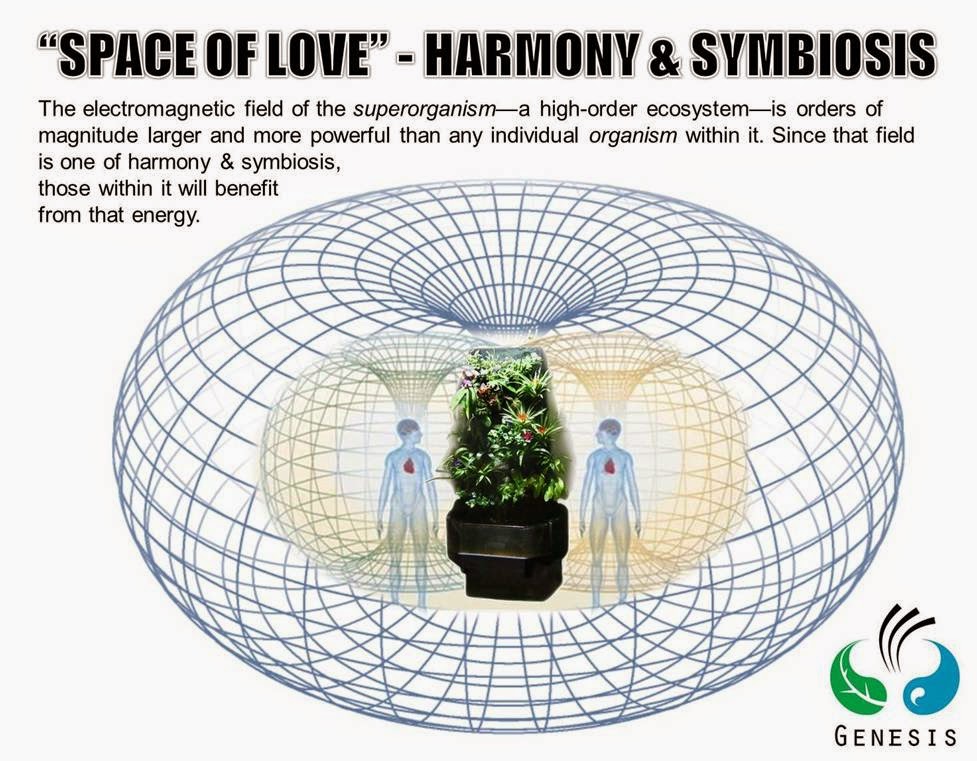
Hopefully we don’t have to go over what an ecosystem is. By now one would hope most people have a grasp of the concept. Of course, from Genesis Eco Fund’s perspective, in addition to what everyone else says it is, to us an ecosystem is also a superorganism which generates a field of harmony and mutual symbiosis…a field of love.

So what is “entrainment,” and what does it have to do with ecosystems? For that, let’s switch from tell to show:

Video: Synchronization of Metronomes 
Credit: Harvard Natural Sciences Lecture Demonstrations

With a video like this It’s easy to see what entrainment is: in this case the shift from diverse to uniform oscillation. (There are MANY versions of this experiment available to watch on You Tube. We chose this one because it’s affiliation with Harvard lends it a bit of credibility in the eyes of sceptics and trolls.)

According to Wikipedia, Entrainment the above video demonstrates Entrainment in physics, or the process where two interacting oscillating systems assume the same period. However, it may refer to a number of additional phenomenon, most notably for our discussion:
1.    Entrainment (chronobiology), the alignment of a circadian system's period and phase to the period and phase of an external rhythm
2.    Entrainment (biomusicology), the synchronization of organisms to an external rhythm including such phenomenon as:
   a.    Brainwave entrainment (entraining one's brainwaves to a desired frequency) 
   b.    Lexical entrainment, the process in conversational linguistics of the subject adopting the terms of their interlocutor
Source: Wikipedia, Entrainment

So today’s article is going to look at each of these phenomenon and hypothesize the effects of an ecosystem based on the established science. 

1. Ecosystems, Entrainment & Chronobiology

According to Wikipedia,

Chronobiology is a field of biology that examines periodic (cyclic) phenomena in living organisms and their adaptation to solar- and lunar-related rhythms.[1] These cycles are known as biological rhythms.”
Image: Biological clock human

Entrainment, within the study of chronobiology, occurs when rhythmic physiological or behavioral events match their period and phase to that of an environmental oscillation. A common example is the entrainment of circadian rhythms to the daily light–dark cycle, which ultimately is determined by the Earth's rotation. The term entrainment is justified because the biological rhythms are endogenous: They persist when the organism is isolated from periodic environmental cues. Of the several possible cues, called zeitgebers (German for 'time-givers', 'synchronizers'), which can contribute to entrainment, bright light is by far the most effective. Exercise may also play a role in determining circadian rhythm.”
Source: http://en.wikipedia.org/wiki/Entrainment_%28chronobiology%29

HYPOTHESIS #1:  Ecosystems should help you sleep better.

An ecosystem, as a superorganism, will be Chrono biologically entrained to the natural rhythms of the planet, and this will be reflected in its electromagnetic field. Anyone in this field will experience some degree of chronobiological entrainment by proxy. Circadian rhythms will have a tendency to normalize and individuals should be able to sleep better.

2. Ecosystems, Entrainment & Biomusicology

According to Wikipedia,
“Entrainment in the biomusicological sense refers to the synchronization of organisms to an external rhythm, usually produced by other organisms with whom they interact socially. Examples include firefly flashing,[citation needed]mosquito wing clapping,[1] as well as human music and dance such as foot tapping.”  
Source: http://en.wikipedia.org/wiki/Entrainment_(biomusicology)

An example of this includes brainwave entrainment, so popular in the New Age movement and even Self-Help circles. Here is a sample:

Video: 1 Hour Theta Brainwave Entrainment Binaural Beats 8 Hz - "Good for learning new Information" 

If you actually follow the advice in the video and try it out (headphones work best), it is unquestionable that the frequencies in the audio are having an effect on your brain. The real question is what if any long-term benefits are you gaining from this? Or is it just a nice way to relax and “cleanse” the mind of all the garbage it accumulated through the day/week.

We are not here to debate the metaphysical benefits of such “meditation technology,” but rather ask the poignant question: is aligning a natural and biological organism to a mechanical (synthesized) frequency really the right way to go?

HYPOTHESIS #2 a):  Ecosystems are the BEST for your brain.

Clinical studies have been done into the calming/healing power of nature sounds. If follows that any biomusical entrainment experienced with a superorganism whose energy frequency is in a constant state of balancing and achievement of optimal function for every organism within it, it follows that any human being (and brain) in the affective zone of said reach will likewise benefit.

Another example of biomusicological entrainment is lexical entrainment, or the tendency to pick-up on and mimic—if not adopt outright—the speech patterns and tendencies of others in social situations. The problem? Disagreements can quickly escalate into arguments if each individual begins getting caught up in the other’s hostility.

Think of a ping-pong match which starts out fairly calm and benign, but quickly escalates into an all-out war.

HYPOTHESIS #2 b):  Ecosystems are the BEST for your relationships.

Be it in the home or in the workplace, if there is a superior enveloping field of love, the tendency for individuals to be afflicted by hostility—and effected by the hostility of others—is reduced. The soothing, calming influence of the entraining effects of the ecosystem act as a buffer, a balm if you will, and a moderating force taking the edge off otherwise tense human interactions.

What’s Next?

Experience it for yourself.

Yes, Genesis Eco Fund has committed itself to promoting and conducting research into ecosystems and their effects on human beings. And we will continually update our blog and website with related research information when it becomes available.

Ultimately, the best way to know for sure if you, your family and/or your organization can benefit from having an ecosystem in your life is to try it. See the difference entrainment and ecosystems have in your life. 

Thursday, March 5, 2015

From NASA’s Air Pollution Video to K-Cups:
Macro to Micro to Macro, we’re All Connected

Video: NASA Animation Shows Asian Air Pollution Moving Across the Globe
“The indigenous understanding has its basis of spirituality in a recognition of the interconnectedness and interdependence of all living things, a holistic and balanced view of the world. All things are bound together. All things connect. What happens to the Earth happens to the children of the earth. Humankind has not woven the web of life; we are but one thread. Whatever we do to the web, we do to ourselves.”
You don’t have to be a member of a Buddhist, Taoist, Hindu, or indigenous tradition to know of the interconnectivity and interdependence of all things. As a matter of fact, you don’t even need to be spiritually inclined at all to recognize this most ancient and universal tenet as a scientifically verified and verifiable fact. Indeed, the above video from NASA should make it clear: on this planet, at least, we’re all in this together…we are all connected.

If you want to see just how deep that interconnectedness runs, there is an excellent article on the topic at: http://www.starstuffs.com/physcon/connected.html.

For today’s discussion, we want to keep it more on a macrocosmic level—that is, limit it to our planet and the ways in which actions in any one region affect the whole.

We know that pollution spreads. The above video by NASA—revealing how aerosol particulates move through the atmosphere—shows how in this case air currents carry pollution to other parts of the planet.

What’s particularly interesting in this case is how this type of airborne particulate matter may be contributing to climate change in unexpected ways. Water vapour in the atmosphere collects around airborne particulates and results in precipitation. More particulates; more precipitation. If those particulates have a certain chemical composition, they may react with the water and result in a solution such as acid rain.

In any case, the pollution is returned to the earth in unexpected locations and ways; namely, as dissolved particulates in water…that goes straight into soil, streams, rivers, lakes and oceans. The water cycle drives all life as we know it on this planet, and anything that’s dissolved in water goes where the liquid water flows…including the bodies of plants, animals and ultimately humans.

Image: Pollution in the Water Cycle 
Credit: Quiksilver Foundation 

It’s very much a case of macro ecological disturbances having very real negative effects at the micro-level of individual human health and wellness.

In a very real sense, the planet earth has its own circulatory and respiratory systems. What we treat as unconscious physical systems (weather patterns, climate) are in fact part of a living breathing megaorganism…if ecosystems can be called superorganism, then a collective ecosystem of ecosystems on a planetary scale is mega indeed. 

But the mega is not immune to micro disturbances; at least, not in the aggregate macro effects. As discussed in The Attlas Project – SEE The World in a New Light:
“The question is not whether there are micro causes that have macro effects.  The real question is what micro opportunities do we seize today that will lead to positive macro effects in the future?”
This is just something we can feel in our gut. (Literally, if anyone has ever had a stomach infection). The point is: if it’s true for positive micro opportunities, then the same is true for negative micro disturbances. It explains why the inventor of the K-Cup, John Sylvan, now regrets having done so.

Originally invented for use in offices and other places where the efficiency and convenience of being able to brew a single-serve coffee out of a small plastic cup seemed to make practical sense, the single-serve disposable coffee-pod phenomenon has ballooned into a behemoth of a multi-billion dollar industry, in which personal taste and convenience drives the bulk of sales, and what critics call an environmental catastrophe.

Keurig K-Cups are non-recyclable, and an estimated 30 billion plastic K-Cups now litter the planet, mostly in land-fills, but also no doubt in the floating plastic debris field in the Pacific Ocean. (What is true for particulates and global air currents is equally true for plastic and global oceanic currents).

It even prompted one group to express their distaste in short film format…

Video: Kill the KCup 

Most everyone likes a good action drama flick. But sadly, humanity has a tendency to make life mimic art versus the other way ‘round. We need to wake up to the fact that there is no such thing as “an isolated incident,” or a “contained ecological disaster.” Likewise, the little choices we make day in and day out affect all of us.

Genesis Eco Fund believes wholeheartedly that the key to bringing the all-important reality of global interconnectivity and interdependence back into the consciousness of society is to bring micro examples of that interconnectivity and interdependence back into people’s lives…ecosystems.

You would never toss your used K-Cup into the ecosystem in your home, workplace, or school. Maybe, just maybe, that in and of itself will get you to start reconsidering tossing that used K-Cup at all…and maybe relax and spend a special moment actually enjoying a fresh-brewed pot of coffee together with family, colleagues, etc. in the interconnected and interdependent company of an ecosystem.

It’s definitely a positive micro opportunity that has potentially profound macro effects. 


Thursday, February 26, 2015

Race to the FINISHED Line?
“Racing Extinction” does more than Ask Tough Questions

Image: Racing Extinction: it’s not a spectator sport anymore

“My goal is to make a film that doesn't just create awareness, but inspires people to get motivated to change this insane path we're on. Films to me aren't just entertainment -- they are for me the most powerful weapon in the world, a weapon of mass construction.”
~ Louie Psihoyos

Weapons of mass construction. A Contradiction in terms, or the coolest term ever? We at Genesis Eco Fund love it, together with Louie Psihoyos, the Academy Award-Winning Director of “The Cove” and Executive Director of the Oceanic Preservation Society.

His latest project, “Racing Extinction” (formerly entitled “6”) goes further than most activist documentaries about exploitation of the natural world. It not only takes action, it documents the actions being taken and shows the world—in an exercise of modern guerilla-media warfare—the err of its ways. 

Video: “Racing Extinction” Official Festival Trailer by Oceanic Preservation Society

Is it effective? Will it ultimately make a difference? Or is it too little, too late? When asked by The Dodo, How bad is it really?  Psihoyos replied, “One paleontologist told me that WWII will be a footnote in human history compared to the current loss of biodiversity that our generation is presiding over.” Source: https://www.thedodo.com/if-the-cove-inspired-you-wait--524234729.html

Translation: Bad. Really bad.

According to Psihoyos, we could lose half of the species on the planet by the end of the century. And although this will not be the first mass extinction to happen in the planet’s history, it will be the first that is caused by human behaviour.

Whether or not this is the case, only time will tell.  The more immediate impact of Psihoyos’ work—on The Cove, Racing Extinction and OPS—is its revelatory value; what the threat of such mass human-caused ecological and genetic devastation reveals about humanity’s appalling relationship with nature.

We all know about humanity’s dismal track record of environmental exploitation, going back thousands of years. But what Psihoyos and his colleagues manage to achieve is show us that things have not improved in many places in the world. If anything, population growth has all but guaranteed that things have gotten much, much worse than they ever were before.

The technology and large scale machinery for the wholesale destruction of species has never been as advanced as it is today; neither the potential profits for individuals and groups participating in the trade of threatened creatures—including but in no way limited to sharks.

And let’s not forget that much of the trade in threatened species is built on a cultural foundation of traditions stretching back thousands of years. Combined with booming population growth and middle class aspirations of material wealth, it is inevitable that demands will be met with supply, as long as that supply is available…no matter the cost.

Such short-sightedness is but one of the many tragedies of the intellectual animal which calls itself “human.”

How do we turn things around?

Psihoyos suggests:

“1. Get your home, school, places of work and worship, and government buildings off of fossil fuels ASAP
2. Explore a plant-based diet

3. Tell everyone you know to see this film
  
The solutions are all upgrades. I've been driving an electric car for five years, and it never goes into the shop because there's only one moving part in the engine -- the rotor -- which lasts forever. I power it with solar panels, I don't pay for gas; in fact, my whole house and studio is powered by the sun. My license plate says “VUS” which stands for Vehicle Using Sun -- it's the opposite of an SUV. My local electric company (which OPS has been working fervently to overthrow) pays us to produce electricity because we generate 140% more energy than we use.” Source: https://www.thedodo.com/if-the-cove-inspired-you-wait--524234729.html

Genesis Eco Fund proposes you look at getting an ecosystem for your home, office/workplace, and school.

Any dog owner with will agree it is all but impossible for them to eat dog. Likewise, someone who had a pet rabbit will likely turn their nose up at rabbit stew. This is because of the deep relationship they have with their pet—and by extension pets in general. 

Living in an ecosystem one becomes more conscious of—and sensitive to—the intrinsic value of nature and ecological systems. One has a much greater appreciation of fish, for instance, when one sees how their lives support the lives of plants in an ecosystem; and, conversely, how the plants support the fish. One appreciates snails as more than escargots when one sees them eagerly cleaning the ecosystem of algae.

An ecosystem is a living, breathing microcosm of the planet as a whole. Being a part of that microcosm gives one a visceral, experiential appreciation for the whole that no intellectual or conceptual argument can match.

Yes, a film can provoke strong emotions and trigger change, but an ecosystem in your life is there always: day in and day out, like a nagging Mother Nature reminding you to make your bed and wash behind your ears, it’s not easily ignored, let alone forgotten.

And so while we applaud the efforts of Louis Psihoyos and others who devote their lives to powerful cinematic reminders—these tools of mass construction—it takes more than a blueprint and a business plan to actually build the future we want. Those 90 minutes, no matter how powerful they are, need to be backed up by real substance 24 hours a day, 7 days a week…in other words, ongoing immersion in a space of love.

That is the power of an ecosystem to enact sustainable long term positive change in peoples’ lives. The kind of sustained changes in attitudes and life choices Louis Psihoyos and his colleagues hope to be able to spark.


Tuesday, February 17, 2015

Artificial Womb from Science Fiction gives birth to Science Fact

(…in a bucket of artificial amniotic fluid and bioethical controversy)

Video: Artificial Wombs(Uterus):The End of Natural Motherhood? The Matrix Begins?
“The future is rosy for bioethicists.”
The revelation that Japanese scientists had incubated goat fetuses in an artificial womb (ectogenesis) using a technique known as extrauterine fetal incubation (EUFI) was first reported in the New York Times in 1996.

Interestingly, the first installment in the wildly popular film franchise The Matrix was released in 1999, just three years after the New York Times article. And one cannot deny the eerie similarity between the design & functionality of the artificial wombs used by Japanese researchers and those depicted in The Matrix films.

Does this mean science fact gave birth to science fiction?

Image Collage by Genesis: Which Artificial Womb came First: Sci-Fi or Sci-Fact?

Well, Aldous Huxley had the jump on this one, actually:
''One by one the eggs were transferred from their test-tubes to the larger containers; deftly the peritoneal lining was slit, the morula dropped into place, the saline solution poured . . . and already the bottle had passed on through an opening in the wall, slowly on into the Social Predestination Room.'' - Aldous Huxley, ''Brave New World.'' 
Source: http://www.nytimes.com/1996/09/29/magazine/the-artificial-womb-is-born.html
Here at Genesis, we do not think of ourselves as naïve. We know that materialist science is barrelling forward in directions which have potentially catastrophic consequences for individual living beings, ecosystems, the environment and this humanity and the planet as a whole. That’s just a fact. (Nuclear weapons, et al).

But at Genesis, we are concerned with matters which penetrate the veil of material reality. We know that the foundation of the physical world is not physical, and that the things that truly matter to man and beast alike lie beneath the veneer of what appears to us as a very solid foundation of everything.

And even though science knows this, it takes a stubbornly materialistic, reductive, secular and ultimately cold-hearted perspective on energy, quantum physics, consciousness. That somehow, although we know physical reality is built from these non-physical building blocks, they are somehow still regarded as inferior; disrespected, in essence, by the intellect which—if we’re honest—wants to know everything and be the centre of our universe. 

That’s because the intellect is the ego. Science likes to “play God” because the ego wants to “be godlike.” 

Don’t believe us? How else does one explain the position of UK bioethicist Anna Smajdor of the University of East Anglia, who believes that pregnancy and childbirth is a barbaric illness which lasts nine months and is occasionally fatal; an illness which should not be tolerated in a truly liberal society:
“Changes to financial and social structures may improve things marginally, but a better solution needs to be found. Either we view women as baby carriers who must subjugate their other interests to the well-being of their children or we acknowledge that our social values and level of medical expertise are no longer compatible with “natural” reproduction.”
Source: http://www.sodahead.com/united-states/is-pregnancy-unethical-yes-says-uk-bioethicist/question-2491463/ originally from an article in Cambridge Quarterly of Healthcare Ethics, Cambridge Quarterly of Healthcare Ethics, January
Ummm…and what about the babies? Where are there rights in all of this? How is it ethical to deny a baby the gestation within the womb? 

Here we see how the intersection of materialist science and liberal intellectualism hit head on to create the conditions which can result in catastrophic cascading effects. The assumption that ectogenesis can be “perfected” is entirely materialistic, mechanical, biological. It assumes that human beings are sacks of ectoplasmic goo surrounded by skin. It denies human beings their essentiality true nature: love.

The fallacious materialist scientific assertion that mind, emotions and love are born out of the physical realm and are by-products of material reality (genetic predisposition and environmental factors) is what allows a scientist to deny the fetus any capacity for mental, emotional well-being and to feel love. Only such a cold-hearted intellectual conclusion could conceive of denying a developing baby the essential connection between it and its mother, and the space of love of the womb (which is BOTH the mother’s womb AND the child’s womb).

Luckily, not everyone think as Ms. Smajdor.
“I would argue that God in her wisdom created pregnancy so Moms and babies could develop a relationship before birth, says Alan Fleischman, professor of pediatrics at Albert Einstein College of Medicine in New York, who directed the neonatal program at Montefiore Medical Center for 20 years.”
Unfortunately, we cannot be naïve. It won't be long (relatively speaking) before fertility clinics begin offering this "service" to women and Homosexual male couples. At first they will offer it to women with ovarian cancer or who have had their uterus removed, in other words, any of the many medical reasons why couples have turned to surrogate mothers. However, when wealthy models, actresses, musicians (or just self-conscious women) see this technology available, there will be cases of women who choose this method over traditional pregnancy for self-serving reasons.

Such babies will not be breastfed, for obvious reasons, and the long term psychological impacts on children "produced" this way will be catastrophic. They will have so little sense, so little feeling of what it means to be a human being...their psyche will be utterly mechanical: easily programmable by the system.

And that is exactly what Aldus Huxley predicted.

As for The Matrix, it uses ectogenesis, malevolent artificial intelligence and hypnotic virtual reality allegorically to tell us something much more significant about ourselves…that we are already in The Matrix. And the ego-intellect is the mechanical intelligence inside of us responsible for every technological terror humanity has ever devised. 

The technology of ectogenesis happens to be one of the most terrifying; an atrocity of the highest order magnitude…one capable of robbing newborns in development of the most precious, important and essential nutrients required for life…the impressions of a loving, caring, nurturing space of mutual harmony and symbiosis…a space of love.

Intellectual animals “produced” in this way will be even more callous, mechanical, heartless than we already are. Ecosystems? Harmony? The Environment? What do any of these things matter to a biological machine produced on an ectogenetic assembly line? Nothing. 

But this is the perfect technology for fulfilling many another dark, ghastly sci-fi vision: from Sauraman’s army of fiercely loyal Uruk-Hai  in The Two Towers to Palpatine’s Clone Army of Stormtroopers.

Video: The creation of the first and badass Uruk-hai, Lurtz- Fellowship of the Ring (2001) 

Video: Begun the clone war has.... 

Take your pick. There’s no shortage of real-life examples and dystopian visions of what atrocities humanity is capable of when we allow materialist science, technology and “liberal intellectualism” (a clever euphemism for egotistical self-interest) to run amok.


Thursday, January 22, 2015

Could Advanced Human Habitat Prevent/Cure Addiction?
New Discovery suggests a Space of Love could be Pivotal

Image by Genesis EcoFund: Addiction Free in a Space of Love 
Credit: “Addiction” 
“Addiction is an adaptation. It's not you. It's your cage.”
~ Bruce Alexander, Professor of Psychology
It’s not you. It’s your cage.

You can imagine our response to reading these words in The Huffington Post’s Blog Entry “The Likely Cause of Addiction Has Been Discovered, and It Is Not What You Think,” by Johan Hari, author of Chasing the Scream: The First and Last Days of the War on Drugs

We could have told you that.

For years Genesis has advocated for reintroducing a healthy space of love into peoples’ lives by means of the incorporation of high-order rainforest ecosystems. The clinical name we gave this is Advanced Human Habitat, and after today perhaps psychologists and addiction specialists may finally take note and hear us out.

But let’s backtrack a bit.

As part of his three and a half year, 30,000 mile journey around the world in search of the real drivers of the war on drugs, Johann Hari stumbled across the likes of psychologist Bruce Alexander and physician Gabor Mate—both Canadian specialists in the field of addiction and mental health.

It was Dr. Mate who, according to Hari, first explained that despite having used the same drug for the same length of time which turns street-users into addicts, those who use elicit drugs for medical purposes simply stop once treatment is no longer required.

Hmmm…so what’s all this about the “opiate effect on the brain” and all the other stuff we’ve heard over the years about the nature of addictive substances? Surely if it’s a neurochemical phenomenon, then ANYONE exposed to “addictive substances” should get addicted. It turns out this is just not the case.

Bruce Alexander’s work suggests why. His experiments with rats showed that when kept in isolation and given a choice between drug-laced water and regular water, rats invariably become “addicted.”
 
However, when Professor Alexander created a “rat park” which consisted of “a lush cage where the rats would have colored balls and the best rat-food and tunnels to scamper down and plenty of friends: everything a rat about town could want,”* rats given the choice of drug-laced water and regular water simply shunned the drugs. They remained sober.

 
Next, after letting his test rats in the isolation cage use for 50 days (become seriously addicted), he transferred them to Rat Park and—remarkably—apart from a few withdrawal symptoms, they stopped their heavy usage and went back to living normal lives.
Although Hari seemed surprised by these results, we at Genesis are not. In his defense, Hari does make the admission and startlingly profound statement which we all need to take to heart:

“So the opposite of addiction is not sobriety. It is human connection.”*

Now, we are not ones to rat out the esteemed author and blogger whose work inspired today’s article and which we are so generously quoting from, but it’s not necessarily human connection which is lacking. Reconnecting with manic individuals and a toxic lifestyle won’t necessarily help prevent/alleviate addiction. We must understand the difference between Professor Alexander’s rat park and the rate race.


There are many people who feel isolated though they are surrounded by others. Many people are shy, or have all-out social anxiety disorder. They may feel more comfortable and at home with a good book, a pet, gardening, in nature, etc.

As a matter of fact, many individuals (ascetics, for instance) who thrive in isolation do so precisely because they “go back to nature.” Be it the lone hunter, trapper, woodsman, explorer, adventurer, castaway, etc., we are all familiar with the reality that nature provides more than enough “meaningful connection.”

Isolation is not absence of people. Isolation is an absence of love.

What human beings need is a space of love.

If we achieve that space of love through loved ones, family, friends, other positive relationships, good. But what happens when nobody’s around? Do we start having “separation anxiety?” Or, what if we don’t have the luxury or good fortune of a loving family, many friends, and positive relationships? What if our human support network is not all it’s cracked up to be? What then?

Advanced Human Habitat, with high-order ecosystems generating fields of collective harmony and symbiosis—spaces of love—can be for us what “Rat Park” was for Professor Alexander’s rats.

Advanced Human Habitat is humanity’s “nicer cage.”

A video can’t do it justice. But use your imagination.

Video: PeapodLife Living Wall EcoSystem Fitch Street – Advanced Human Habitat creates a Space of Love to help fight Addiction

Can’t you see this as a BIG STEP in the right direction toward preventing and alleviating addictions and many of the other “coping mechanism” we have for our inherently “isolated” lives?


=======================
* All Quotes in today’s blog sourced from Huffington Post “The Blog”: The Likely Cause of Addiction Has Been Discovered, and It Is Not What You Think by Johann Hari, Posted: 01/20/2015 3:20 pm EST

Tuesday, November 25, 2014

What can the Ferguson Riots teach us About Ourselves and the Flower of Life?

Image: Rioters surround a Saint Louis County Police cruiser as the city of Ferguson and the whole U.S. reacts to a grand jury’s decision not to indict Ferguson police officer Darren Wilson in the shooting death of unarmed teenager Michael Brown.
“Folk caught up in a riot aren't our cousins and sisters, our brothers and uncles. They are part of a big animal with many arms and claws, armed with stones and sticks.”
~ Tamora Pierce, Terrier
Yesterday’s decision by the grand jury not to indict Ferguson police officer Darren Wilson in death of unarmed teenager Michael Brown set of a firestorm of controversy and protest across the United States. In Ferguson itself, the anger and outrage intensified and the usual angry mob mentality was set loose on the town.

Riots, looting, burning police cars and businesses. It’s all over the news and the Internet. As is the outrage over the decision, discussions of racism and inequality, violence and acceptable use of force, law enforcement the reasonable expectations placed on officers facing possible harm, etc.

Genesis Eco Fund is not here to debate any of those issues. We leave that to the masses and the pundits. What we are here to do is extract practical knowledge that everyone can use—knowledge about ourselves, each other, how we interrelate on a fundamental level, and how our awareness of those foundational interrelationships can lead to strategies for living a more balanced, harmonious life.

In the Eye of the Storm

We all know what it’s like to “get caught up in” the moment. Be it at a rock concert, a party, a family gathering, or any group dynamic, we’ve felt ourselves “sucked into” as state of elation, excitement, laughter, anger (or even rage), fear, sadness or any number of emotional states.

If our emotional state resulted in us behaving in a certain way which we later regretted, we might even have chalked is up as “in the heat of the moment,” or “a victim of mob mentality.” But what was really going on with us? Truly, we were caught in a maelstrom of energy.   

Image: In the eye of the storm: Electromagnetic Field Vortex 

Recent research has shown the energy field of the heart, our emotional centre, to be 100,000 times stronger electrically and 5,000 times stronger magnetically than that of the brain, or intellectual centre.

Physics demonstrates that a change in our electromagnetic field causes transformation at the atomic level. Our electromagnetic field reflects our emotional state; and, the state of others’ electromagnetic fields can affect our electromagnetic field…affect our state.

Video: Heart’s Intuitive Intelligence and how electromagnetic fields generated by the heart (emotional energy fields) interact.

If we observe ourselves during moments of emotional confrontation with another, we can actually feel ourselves affected, influenced by their state, as shown in the above excellent video by the Institute of HeartMath. The more sensitive we are, the more likely it is we will be affected.

Quite simply, we are experiencing interference patterns from a “negatively charged” electromagnetic field. The flow of energy is of a certain frequency reflecting the emotional state of one individual interferes with the frequency of another and thus emotional state of another. Pretty simple, really, and something anyone can observe and experience directly, consciously, if they pay attention.

Image: Interface between electromagnetic fields. 

But this still doesn’t explain mob mentality. After all, are we not still all individuals? How is it that one person’s negative energy can interfere with the electromagnetic field of hundreds of people? The answer is simple, and something known to humans thousands of years ago, expressed in the symbol of the flower of life.

Video: How electromagnetic fields (torus) compound each other to create powerful morphogenetic fields, shown in “the flower of life.” 

In the above video taken from the documentary film Thrive, we see how torus, the shape of our electromagnetic field, compound one another in 3-dimensional space to produce a larger morphogenetic field magnitudes larger and more powerful than the electromagnetic field of any individual. Any new individual entering the larger field is affected by the state of the field, which in turn reflects the state of all individuals within it. The cascading effect from one individual to another compounds and the whole larger field begins to exert a tremendous power over the individuals caught within it.

This is why, for instance, completely law-abiding citizens can find themselves committing crimes in a mob they would never have done as an individual. The overarching electromagnetic field has them; their individual emotional state is being defined by the morphogenetic field.

This is how the planet’s electromagnetic field is partly created. All things which have an electromagnetic field are part of the megaorgansim of the planet. Its various ecosystems being superorganisms, themselves having morphogenetic fields made up of electromagnetic fields of individual organisms.

Image: Electromagnetic field of the planet 

The Good News from Ferguson

What’s true for riots fed by anger, frustration, hear, rage and other negative emotions, is equally true for peace, love, compassion, empathy, harmony and other positive emotions.

What’s more, anyone who has spent any time in nature knows this is the case. When we immerse ourselves in the morphogenetic field of a beautiful natural environment, we feel, immediately, the calming, soothing, peaceful, harmonious, loving state of that natural environment.

The power of nature to heal us emotionally and physically is related directly to this energetic influence over our electromagnetic field. Our field may be charged negatively, according to our state, but an ecosystem functions on collective harmony and symbiosis. Nature is love.

And so, indoor ecosystems, like those produced by PeapodLife, create spaces of love.

Image: An ecosystem 

Ecosystems are never negatively charged, unless they are dying.  But ecosystems are designed for sustainability, adaptability and longevity. It takes a shift in the larger electromagnetic field of the planet for an ecosystem to die—the ravages of human stupidity notwithstanding.

Regardless, one can see how beneficial it would be to have such an overarching positively charged morphogenetic field in one’s life—home, workplace, school, healing centre, etc.

Imagine what it would be like to be able to feel the same way you do when you go up north, camping, skiing, or to a tropical paradise…without having to go anywhere? Imagine the benefits to humanity if they began living in Advanced Human Habitat—advanced habitat for humans; habitat for advanced humans.