Tuesday, February 3, 2015

World Wetlands Day 2015:
Wetlands for Our Future

Image: WLE Postcard (back/front) highlights ecosystem services provided by Southeast Asian wetlands
Source: http://wle.cgiar.org/blog/2015/02/02/wetland-ecosystem-services/  

February 2nd 1971, the Convention of Wetlands was adopted and began the annual tradition of celebrating World Wetlands Day.

This year, the International Water Management Institute, or IWMI, has marked the occasion with the theme, Wetlands for Our Future, a photo contest, and communication materials available for download.  

In addition, they have produced the following infographic which highlights how broad-reaching the impacts of wetlands are on all of us.

Image: IWMI Infographic “Wetlands at Work” Source: http://www.iwmi.cgiar.org/Publications/infographics/infographic-wetlands-at-work.pdf

What is particularly telling is the foundational impact of wetlands on ecosystems.

The Research Program on Water, Land and Ecosystems (WLE) and International Water Management Institute are a part of CGIAR—A Global Agricultural Research Partnership.

CGIAR research partnerships focus on reduction of rural poverty, improvement in food security, nutrition and health, and sustainability in managing natural resources.

What International Wetlands Day signifies is the recognition that ecosystems are the backbone of sustainable agriculture, and that ecosystems themselves have a foundation—wetlands…water.

More than anything else, wetlands produce living water. This ionized energy-rich flow is capable of supporting massive plant and animal populations, in addition to providing naturally filtered water for human consumption, so long as it is an agricultural ecosystem.

What wetlands cannot support (what no living system can support) is industrial agriculture model built on a paradigm of exploitation.

Any attempt to use wetlands as a “silver bullet” to support inherently unsustainable western-style industrialized agriculture is doomed to fail. Trying to bring increased productivity and efficiency to the rural poor using an anti-ecosystem model, supported by what can only support ecosystems, is folly.

That said, opportunities do exist to uncover and embrace nature’s modus operandi, thereby producing everything required by local populations in environmentally responsible and sustainable ways. In other words, to comprehend how wetlands and other ecosystems interact, and use that comprehension to enable those systems to flourish naturally. 

Any exploitative model, however ingenious it may seem, will be in a constant state of conflict with the underlying natural world which seeks harmony and symbiosis. An ecosystem approach, built on harmony and symbiosis, will be met by nature as an ally, and will be supported by nature to succeed.

It’s an infinitely complex process summed up by a very simple fact. All research in this area should be focused on restoring humanity’s harmony and symbiotic relationship with the ecosystem—wetlands included. How can we contribute and support ecosystem (as oppose to “exploit and manage” resources).


Thursday, January 22, 2015

Could Advanced Human Habitat Prevent/Cure Addiction?
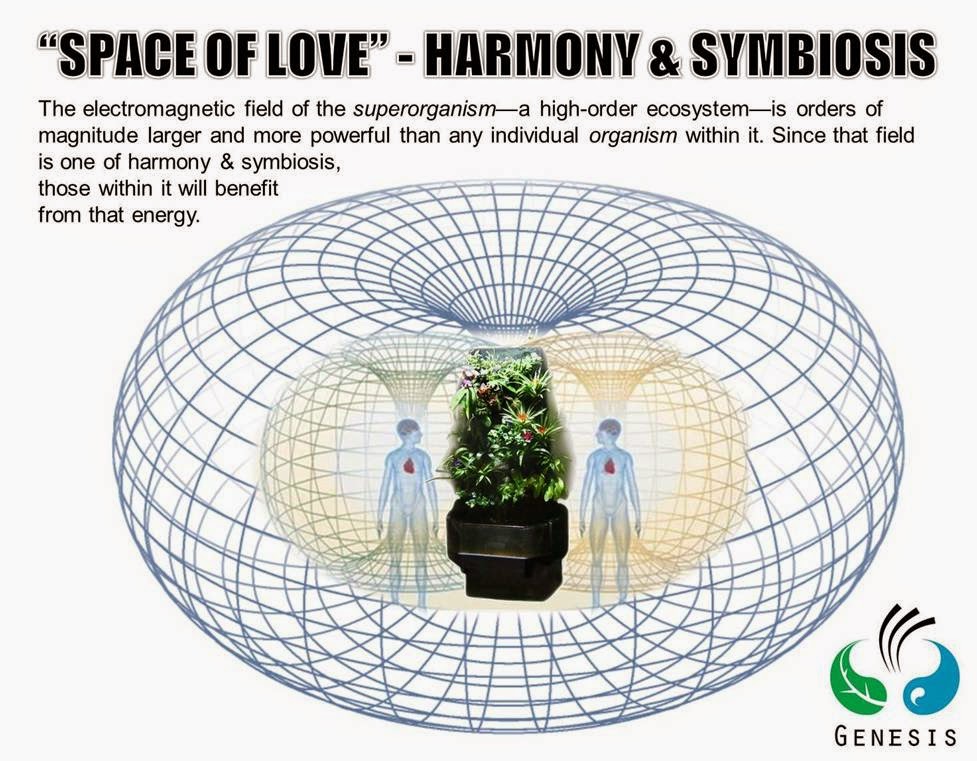
New Discovery suggests a Space of Love could be Pivotal

Image by Genesis EcoFund: Addiction Free in a Space of Love 
Credit: “Addiction” 
“Addiction is an adaptation. It's not you. It's your cage.”
~ Bruce Alexander, Professor of Psychology
It’s not you. It’s your cage.

You can imagine our response to reading these words in The Huffington Post’s Blog Entry “The Likely Cause of Addiction Has Been Discovered, and It Is Not What You Think,” by Johan Hari, author of Chasing the Scream: The First and Last Days of the War on Drugs

We could have told you that.

For years Genesis has advocated for reintroducing a healthy space of love into peoples’ lives by means of the incorporation of high-order rainforest ecosystems. The clinical name we gave this is Advanced Human Habitat, and after today perhaps psychologists and addiction specialists may finally take note and hear us out.

But let’s backtrack a bit.

As part of his three and a half year, 30,000 mile journey around the world in search of the real drivers of the war on drugs, Johann Hari stumbled across the likes of psychologist Bruce Alexander and physician Gabor Mate—both Canadian specialists in the field of addiction and mental health.

It was Dr. Mate who, according to Hari, first explained that despite having used the same drug for the same length of time which turns street-users into addicts, those who use elicit drugs for medical purposes simply stop once treatment is no longer required.

Hmmm…so what’s all this about the “opiate effect on the brain” and all the other stuff we’ve heard over the years about the nature of addictive substances? Surely if it’s a neurochemical phenomenon, then ANYONE exposed to “addictive substances” should get addicted. It turns out this is just not the case.

Bruce Alexander’s work suggests why. His experiments with rats showed that when kept in isolation and given a choice between drug-laced water and regular water, rats invariably become “addicted.”
 
However, when Professor Alexander created a “rat park” which consisted of “a lush cage where the rats would have colored balls and the best rat-food and tunnels to scamper down and plenty of friends: everything a rat about town could want,”* rats given the choice of drug-laced water and regular water simply shunned the drugs. They remained sober.

 
Next, after letting his test rats in the isolation cage use for 50 days (become seriously addicted), he transferred them to Rat Park and—remarkably—apart from a few withdrawal symptoms, they stopped their heavy usage and went back to living normal lives.
Although Hari seemed surprised by these results, we at Genesis are not. In his defense, Hari does make the admission and startlingly profound statement which we all need to take to heart:

“So the opposite of addiction is not sobriety. It is human connection.”*

Now, we are not ones to rat out the esteemed author and blogger whose work inspired today’s article and which we are so generously quoting from, but it’s not necessarily human connection which is lacking. Reconnecting with manic individuals and a toxic lifestyle won’t necessarily help prevent/alleviate addiction. We must understand the difference between Professor Alexander’s rat park and the rate race.


There are many people who feel isolated though they are surrounded by others. Many people are shy, or have all-out social anxiety disorder. They may feel more comfortable and at home with a good book, a pet, gardening, in nature, etc.

As a matter of fact, many individuals (ascetics, for instance) who thrive in isolation do so precisely because they “go back to nature.” Be it the lone hunter, trapper, woodsman, explorer, adventurer, castaway, etc., we are all familiar with the reality that nature provides more than enough “meaningful connection.”

Isolation is not absence of people. Isolation is an absence of love.

What human beings need is a space of love.

If we achieve that space of love through loved ones, family, friends, other positive relationships, good. But what happens when nobody’s around? Do we start having “separation anxiety?” Or, what if we don’t have the luxury or good fortune of a loving family, many friends, and positive relationships? What if our human support network is not all it’s cracked up to be? What then?

Advanced Human Habitat, with high-order ecosystems generating fields of collective harmony and symbiosis—spaces of love—can be for us what “Rat Park” was for Professor Alexander’s rats.

Advanced Human Habitat is humanity’s “nicer cage.”

A video can’t do it justice. But use your imagination.

Video: PeapodLife Living Wall EcoSystem Fitch Street – Advanced Human Habitat creates a Space of Love to help fight Addiction

Can’t you see this as a BIG STEP in the right direction toward preventing and alleviating addictions and many of the other “coping mechanism” we have for our inherently “isolated” lives?


=======================
* All Quotes in today’s blog sourced from Huffington Post “The Blog”: The Likely Cause of Addiction Has Been Discovered, and It Is Not What You Think by Johann Hari, Posted: 01/20/2015 3:20 pm EST

Tuesday, December 16, 2014

Did the Romans know more about the Nature of Concrete than we do?

Image: The concrete walls of Trajan’s Markets in Rome have stood the test of time and the elements for nearly 2,000 years.
Credit: Marie Jackson 
Source: sciencedaily.com: Back to future with Roman architectural concrete: Advanced light source reveals key to longevity of imperial Roman monuments
“The architect should be equipped with knowledge of many branches of study and varied kinds of learning, for it is by his judgement that all work done by the other arts is put to test. This knowledge is the child of practice and theory.”
~ Marcus Vitruvius Pollio, De architectura, ~ 15BCE.
Source: http://en.wikiquote.org/wiki/Vitruvius
It’s never an easy idea to swallow: the ancients may have known things that we don’t. They were able to accomplish things which we can’t, despite all our knowledge and technology.

Actually, the idea that the ancients were superior to us in any way at all is a “crackpot notion” which is never acknowledged by present day “experts,” despite there being hundreds of observable phenomena and material achievements which defy all explanation by modern scholars.

Egypt is a great source of such enigmas. From the colossal—the Great Pyramid of Giza itself—to the small—onyx vessels with a tiny neck perfectly carved from a single stone, no one knows for sure how the Egyptians could manage various feats of engineering given the “consensus” view of what tools, materials and technology were available to them at the time.

The Roman civilization had its own secrets which scientists have only recently begun to decode. Among them, the incredible durability and longevity of Roman concrete.

From the Pantheon, Trajan’s Markets and the Colosseum to any number of incredible concrete structures throughout the ancient capitol and beyond, modern architectural engineers can only gaze in wonder and marvel at technology which has stood the test of time and the elements for almost two millennia.


Image: Gardiner Expressway versus Roman Concrete. 

And if you think the above comparison of Roman concrete to the Gardiner Expressway, consider that Marie Jackson, lead author of two papers on the subject, said “Roman concrete has remained coherent and well-consolidated for 2,000 years in aggressive maritime environments…It is one of the most durable construction materials on the planet, and that was no accident. Shipping was the lifeline of political, economic and military stability for the Roman Empire, so constructing harbors that would last was critical.” Source: http://newscenter.berkeley.edu/2013/06/04/roman-concrete/

Well thanks to Jackson, a team of researchers and advanced imaging techniques, modern technology has a shot at redemption.

“Using the Advanced Light Source at Lawrence Berkeley National Laboratory (Berkeley Lab), a research team from the University of California, Berkeley, examined the fine-scale structure of Roman concrete. It described for the first time how the extraordinarily stable compound – calcium-aluminum-silicate-hydrate (C-A-S-H) – binds the material used to build some of the most enduring structures in Western civilization.” Source: http://newscenter.berkeley.edu/2013/06/04/roman-concrete/

Here’s an idea of what it looks like:

Image: This scanning electron microscope image shows crystals of a rare mineral, Al-tobermorite, magnified about 25,000 times. UC Berkeley researchers characterized Al-tobermorite in samples of Roman concrete. Credit: UC Berkeley 


According to researchers, manufacturing Roman concrete not only promises a more durable product; it’s more sustainable too: using far less heat energy than the standard Portland cement (the key ingredient in modern concrete) and leaves a much smaller carbon footprint.

At 19 billion tons, some estimates place the carbon emission contribution of Portland cement to be 7% of our overall carbon footprint. No small sum, given all other sources of atmospheric CO2.

At Genesis Eco Fund, we think there’s something more fundamental about this research, which is sadly lost on the researchers but significant.

 Image: Nikola Tesla’s assertion that crystals are alive.   
“Crystals are living beings at the beginning of creation."
~ Nikola Tesla
Crystals are alive.

The descriptions provided about how Roman Concrete was produced—and that it was composed of mortar formulated from lime, volcanic ash and chunks of volcanic tuff and brick—indicate an aggregate which is alive versus the lifeless concrete of today.

Consider:

“The mineralogical changes that Jackson and her collaborators observed showed the mortar reproduction gaining strength and toughness over 180 days as calcium-aluminum-silicate-hydrate (C-A-S-H) cementing binder coalesced and strätlingite crystals grew in interfacial zones between volcanic scoria and the mortar matrix. The toughening of these interfacial zones is reflected in the bridging crack morphology, which was measured by co-author Landis at the University of Maine, using computed tomography scans of the fractured mortar specimens. These experimental results correlate well with computations of increasing fracture energy determined by co-author Brune, now at Dupont Technologies. The strätlingite crystals show no corrosion and their smooth surfaces suggest long-term stability, similar to geological strätlingite that persists for hundreds of thousands of years.” Source: http://www.sciencedaily.com/releases/2014/12/141215185026.htm

In essence, the situ crystallization of the strätlingite crystals produces an interfacial microstructure which is superior to that of modern-day Portland cement, whose porosity is what gives rise to cracks and fractures.
In the end, it would seem the Romans knew something about the true nature of crystals and crystallization and its effects on the nature of concrete. 

The bottom line?

Given the climatic changes and geological challenges facing modern civilization, we would do well to continue looking into ancient methods and materials which have stood the test of time. More importantly, to expand our minds and embrace ancient philosophies related to the nature of things, philosophies which modern science is slowly discovering were really “natural philosophies” that is, the original name given to the study we know today as science.

Certainly, using living materials is the hallmark of any truly Advanced Civilization, and a requisite for Advanced Human Habitat.

Tuesday, December 9, 2014

One Million Children in Meditation
Show us the Power of Ecosystems

Image by GenesisEcoFund: Flower of Life Blooms in Thailand: 1 Million Children Strong  
Credit: BBC Video  Source: http://www.bbc.com/news/world-asia-21016612

“The first goal is to get 10,000 students practising Transcendental Meditation in the U.S. to create a wave of peace in America that will be a catalyst for peace in the world…”
~ David Lynch 
 

A few weeks ago we wrote a blog asking What can the Ferguson Riots teach us About Ourselves and the Flower of Life? And while this was all well and good, today we offer an expansion on the subject of the flower of life, morphogenetic fields, the impact of collective energy and consciousness on our well being. This time, from what we hope will be a more positive example.

According to organisers of the V-Star Change the World project, their most recent event—which brings together schoolchildren for a day of meditation—was attended by one million children. The event was held at Phra Dhammakaya Buddhist temple near Bangkok, Thailand.

As the following BBC report states, the event has not been met without some controversy in the past, with critics claiming it to be everything from a publicity stunt to a cult. Nonetheless, the Temple believes bringing children together to meditate on masse can indeed change the world.

Video Screenshot & Link: 'One million children' join Buddhist meditation event

So what does a million children have to do with ecosystems?

As we previously explored in the aforementioned post about Ferguson MO, we each have an electromagnetic field which, when it is compounded with that of others, creates a more intense energy field.

We asked the question, “How is it that one person’s negative energy can interfere with the electromagnetic field of hundreds of people?”  The answer was “the flower of life,” an ancient symbol describing the interaction of electromagnetic fields in 3-dimensional space and the resulting phenomena of the morphogenetic field and the bizarre and/or violent behaviour of individuals caught up in “crowd mentality.”

The following video excerpt from Thrive shows how this happens:

Video: How electromagnetic fields (torus) compound each other to create powerful morphogenetic fields, shown in “the flower of life.”

Just as negatively-charged morphogenetic fields have a negative effect on individuals, positively charged ones will have a positive, beneficial effect.  

And it’s not just people who generate these fields. All living things have an electromagnetic field, even the planet itself (which is the source of the aurora borealis). In fact, the planet’s field is partly made up of the field of every living thing living on it. This is where the claim a million meditating children can change the world comes from…it’s literally true that a million beings resonating in harmony will have a positive harmonic effect on the whole.

Now imagine being a part of that resonance field…a field of harmony, peace, joy, happiness, and love? Innocence, intensely expressed, compounded.

We cannot orchestrate such events on a regular basis in our life. But what we can do is create a similar space of love where we live, work and heal using a high order rainforest ecosystem.

Image: An ecosystem 

Like one million meditating children, an ecosystem has the benefit of numbers. Though not in the millions, ecosystems work in the range of billions of organism—yes, billions…we cannot discount the existence of bacteria and other microbes whose function is paramount to collective harmony and symbiosis of the superorganism.

Ecosystems resonate with one shared frequency of balance and harmony. And, even moreso than children, ecosystems are innocent. They have no ego to speak of. This naturally cleansing environment is why people are so drawn to escape big cities and the collective consciousness of chaos of modern living to seek refuge out in nature. We need to surround and immerse ourselves in the energy which only nature can provide: pure, balancing, refreshing…truly alive.

Truly, we all stand to benefit from getting the flower of life to bloom in our lives.


Tuesday, November 25, 2014

What can the Ferguson Riots teach us About Ourselves and the Flower of Life?

Image: Rioters surround a Saint Louis County Police cruiser as the city of Ferguson and the whole U.S. reacts to a grand jury’s decision not to indict Ferguson police officer Darren Wilson in the shooting death of unarmed teenager Michael Brown.
“Folk caught up in a riot aren't our cousins and sisters, our brothers and uncles. They are part of a big animal with many arms and claws, armed with stones and sticks.”
~ Tamora Pierce, Terrier
Yesterday’s decision by the grand jury not to indict Ferguson police officer Darren Wilson in death of unarmed teenager Michael Brown set of a firestorm of controversy and protest across the United States. In Ferguson itself, the anger and outrage intensified and the usual angry mob mentality was set loose on the town.

Riots, looting, burning police cars and businesses. It’s all over the news and the Internet. As is the outrage over the decision, discussions of racism and inequality, violence and acceptable use of force, law enforcement the reasonable expectations placed on officers facing possible harm, etc.

Genesis Eco Fund is not here to debate any of those issues. We leave that to the masses and the pundits. What we are here to do is extract practical knowledge that everyone can use—knowledge about ourselves, each other, how we interrelate on a fundamental level, and how our awareness of those foundational interrelationships can lead to strategies for living a more balanced, harmonious life.

In the Eye of the Storm

We all know what it’s like to “get caught up in” the moment. Be it at a rock concert, a party, a family gathering, or any group dynamic, we’ve felt ourselves “sucked into” as state of elation, excitement, laughter, anger (or even rage), fear, sadness or any number of emotional states.

If our emotional state resulted in us behaving in a certain way which we later regretted, we might even have chalked is up as “in the heat of the moment,” or “a victim of mob mentality.” But what was really going on with us? Truly, we were caught in a maelstrom of energy.   

Image: In the eye of the storm: Electromagnetic Field Vortex 

Recent research has shown the energy field of the heart, our emotional centre, to be 100,000 times stronger electrically and 5,000 times stronger magnetically than that of the brain, or intellectual centre.

Physics demonstrates that a change in our electromagnetic field causes transformation at the atomic level. Our electromagnetic field reflects our emotional state; and, the state of others’ electromagnetic fields can affect our electromagnetic field…affect our state.

Video: Heart’s Intuitive Intelligence and how electromagnetic fields generated by the heart (emotional energy fields) interact.

If we observe ourselves during moments of emotional confrontation with another, we can actually feel ourselves affected, influenced by their state, as shown in the above excellent video by the Institute of HeartMath. The more sensitive we are, the more likely it is we will be affected.

Quite simply, we are experiencing interference patterns from a “negatively charged” electromagnetic field. The flow of energy is of a certain frequency reflecting the emotional state of one individual interferes with the frequency of another and thus emotional state of another. Pretty simple, really, and something anyone can observe and experience directly, consciously, if they pay attention.

Image: Interface between electromagnetic fields. 

But this still doesn’t explain mob mentality. After all, are we not still all individuals? How is it that one person’s negative energy can interfere with the electromagnetic field of hundreds of people? The answer is simple, and something known to humans thousands of years ago, expressed in the symbol of the flower of life.

Video: How electromagnetic fields (torus) compound each other to create powerful morphogenetic fields, shown in “the flower of life.” 

In the above video taken from the documentary film Thrive, we see how torus, the shape of our electromagnetic field, compound one another in 3-dimensional space to produce a larger morphogenetic field magnitudes larger and more powerful than the electromagnetic field of any individual. Any new individual entering the larger field is affected by the state of the field, which in turn reflects the state of all individuals within it. The cascading effect from one individual to another compounds and the whole larger field begins to exert a tremendous power over the individuals caught within it.

This is why, for instance, completely law-abiding citizens can find themselves committing crimes in a mob they would never have done as an individual. The overarching electromagnetic field has them; their individual emotional state is being defined by the morphogenetic field.

This is how the planet’s electromagnetic field is partly created. All things which have an electromagnetic field are part of the megaorgansim of the planet. Its various ecosystems being superorganisms, themselves having morphogenetic fields made up of electromagnetic fields of individual organisms.

Image: Electromagnetic field of the planet 

The Good News from Ferguson

What’s true for riots fed by anger, frustration, hear, rage and other negative emotions, is equally true for peace, love, compassion, empathy, harmony and other positive emotions.

What’s more, anyone who has spent any time in nature knows this is the case. When we immerse ourselves in the morphogenetic field of a beautiful natural environment, we feel, immediately, the calming, soothing, peaceful, harmonious, loving state of that natural environment.

The power of nature to heal us emotionally and physically is related directly to this energetic influence over our electromagnetic field. Our field may be charged negatively, according to our state, but an ecosystem functions on collective harmony and symbiosis. Nature is love.

And so, indoor ecosystems, like those produced by PeapodLife, create spaces of love.

Image: An ecosystem 

Ecosystems are never negatively charged, unless they are dying.  But ecosystems are designed for sustainability, adaptability and longevity. It takes a shift in the larger electromagnetic field of the planet for an ecosystem to die—the ravages of human stupidity notwithstanding.

Regardless, one can see how beneficial it would be to have such an overarching positively charged morphogenetic field in one’s life—home, workplace, school, healing centre, etc.

Imagine what it would be like to be able to feel the same way you do when you go up north, camping, skiing, or to a tropical paradise…without having to go anywhere? Imagine the benefits to humanity if they began living in Advanced Human Habitat—advanced habitat for humans; habitat for advanced humans.


Thursday, November 20, 2014

How Easily Climate Change
is Lost on “Rational People”

Image: “Red Tide” The production and distribution of carbon dioxide has never looked so beautiful -- or so disturbing. 
Video Screenshot by Michael Francco/CNET 

Today I saw and re-posted a NASA video showing a year in the life of the planet’s carbon dioxide concentration, movement, etc. I didn’t say anything about it…just re-posted it because I thought it was interesting and telling. See for yourself:

Video: NASA | A Year in the Life of Eaeth’s CO2 

No sooner did I post this video to my timeline, than a friend of mine chimed in with how “deceptive” the video was because map projections of this kind are distorted.

Image: A Miller cylindrical projection maps the globe onto a cylinder.   
Source: http://en.wikipedia.org/wiki/Map_projection


He then posted this image of a Goode homolosine projection overlaid on top of NASA’s map to show just how significant the distortion (and deception) was:

Image: More accurate map of the world overlaid NASA’s CO2 map

This is the kind of knee-jerk intellectual reaction which damns the whole global warming movement (and other long-range environmental, economic and socio-political threats), on the basis of distorted or deceptive messaging, as if the choice of map was made to specifically make global warming seem worse (and not the simple reason that such digital projections are able to show movement around the globe.

Okay, in all fairness maybe NASA should have used a Mollweide projection:

Image: Sea-surface freon levels measured by the Global Ocean Data Analysis Project. Projected using the Mollweide projection.

But from the perspective of anyone “on the fence” of climate change, what was probably just an arbitrary decision / choice based on available technology, satellite imagery, or software interpolation, becomes an instant conspiracy theory that potentially calls into question the whole problem of climate change! And of course, their mind quickly and easily pieces together that perfectly rational explanation.

In response to all this hoopla about distorted maps and secret NASA agendas to overblow the climate change issue, I posted the following image in response, with the explanation that atmospheric carbon is NOT the whole picture. The oceans are acting as a giant carbon sink, and the effect it is having on corals (the nurseries, incubators and hatcheries of the ocean food chain...OUR seafood chain) is absolutely DEVASTATING.

Image: “Ocean acidification is a reduction in surface ocean pH levels due to the increasing absorption of carbon dioxide. When CO2 dissolves in water, carbonic acid is formed. The saturation of carbonic acid decreases the ability of many marine organisms to build and maintain their shells and skeletal structures.” Source: http://ecocidealert.com/?tag=ocean-acidification

My point being this: THE MORE RED ON NASA’S MAP, THE BETTER!

To this, my friend replied that while my “desire for action is to be commended, it should not be built on deception.”

And this is how easy it is for the ego-intellect to dismiss anything. We see it all the time. Materialist scientists denying metaphysical phenomenon because there is no physical evidence to support it; doctors dismissing entire bodies of research because they do not value “anecdotal evidence;” Judges throwing out cases because someone forgot to “dot an i” or “cross a t” etc.

This tendency to dismiss that which doesn’t match exactly, or discounting the deeper broader essence of a situation based on some minor technical detail is called “A-Type” thinking by some, “perfectionism” by others, but at its core it’s obsession with accuracy… with “the facts” and “exactitude”…with “being right.” This obsession of ego-intellect is akin to a computer’s inability to surmise what a user wants it to do. Unless you know EXACTLY what buttons to push, when to push them, etc. you are stuck. Why? BECAUSE IT IS A DUMB MACHINE.

Wait a minute…do we sense a contradiction here?  Yes SENSE…feel…you know, those things that make us human?

How is it that the intellect most resembles a stupid machine when most asserts its “correctness?” The contradiction is real; is absolute. One cannot deny the inflexible mind is more machine-like in its processing. After all, like a machine, it can only “accept” inputs which “compute.”

Is this the path to deepening our connection with humanity? What about our connection with nature?

As my friend’s reaction to NASA’s video illustrated, his mind jumped to the inaccuracy of the map, and therefore loss of credibility of the information, questioning the reality of the situation being illustrated, etc. In short, the plight of the planet was “trumped” by the need for “accurate” depiction of said plight.

But humans exaggerate EVERYTHING. It’s called DRAMATIC EFFECT. We not only tell stories, we live them. And the reason we use drama, hyperbole, metaphor, symbolism, allegory, etc. is to put emphasis where it is needed…ON THE POINT…and to penetrate the machinations of ego-mind and try to reach their CONSCIENCE…their HEART.

To have an enhanced connection with humanity or nature requires something a computer or machine completely lacks…CONSCIOUSNESS. And, by the fact of observation, so too does ego-intellect completely lack consciousness. Conscience. We know this because of its obsession with correctness, with being right, and its limitations of understanding only those inputs which “compute,” exactly as a computer…which was made in the image of ego-intellect. Binary thinking: right or wrong, black or white, yes or no, us or them, on or off…1/0.

I’ll close today’s article with another video. I am curious what my friend would have to say about the subject matter and whether or not the cause being discussed is deceptive or not.

Video: ฉันไม่เคยรู้มาก่อน - มูลนิธิเพื่อสุนัขในซอย ( Soi Dog Foundation ) 

The bottom line is this: the point, the essence of life DOES NOT EXIST IN THE MIND…it is not an equation, or a computer program, or something which the intellect can put in a box and say “this is it to the exclusion of everything else.” The essence of nature, of humanity, is in a space the intellect cannot understand, but the consciousness can comprehend. It is this space that gives rise to beauty, compassion, love, altruism, generosity and all the good aspects of humanity…all the faculties completely at odds with the self-interested machinations of ego-intellect.

Tuesday, November 11, 2014

Consumer Product Companies:
Charmingly Fresh or Naturally Deceptive?

Video: THE CONSUMER DICTIONARY: FRESH | The Checkout | ABC1 
“The art of pleasing is the art of deception.”
~ Luc de Clapiers
“The art of pleasing is the art of deception.”
~ Luc de Clapiers


The issue of product labelling is not a new one. Packaged goods companies have resisted the use of honest straightforward language in advertising and on product labels for decades.

The whole controversy around GMO labelling of products is the episode of the legal language merry-go-round. And it’s not our intention to get into that debate here. Rather, we want to focus on some of the more “benign” and sneaky uses of language which permeate the consumer landscape.

The above video shows just how clever and slippery companies are about the use of terms which have very specific definitions. Without being redundant, it’s our belief that companies using the term “fresh” this loosely to describe their products are far from being endearingly “fresh” (as in when a man or woman is being forward, flirtatious or bold).

There’s another favourite catch-all word for marketers: “natural,” “all natural,” “naturally,” etc. Combined with beautiful graphics of plants, animals, landscapes, water and of course the ubiquitous colour “GREEN,” the result is a plethora of products with lousy labels.


So pervasive is the practice of misleading or outright deceptive marketing, advertising and packaging of so-called “environmentally, wholesome, holistic” products that a whole new term was coined to describe the practice: GREENWASHING.

Image: What would Andy Warhol say about Campbell’s Greenwashed Soup?

Why do they do it? Why do companies insist on misleading and deceptive labelling, especially when it comes to trying to improve the impression of their product as fresh, natural, healthy, eco-friendly, etc? Is it possible that they’re just naturally deceptive…but downright pathological?

Video: THE CORPORATION [6/23] The Pathology of Commerce

We’ll leave the ultimate judgment in your hands. But judge wisely…with your dollar and your voice. Otherwise, the power will naturally remain in the hands of the pathologically deceptive.